
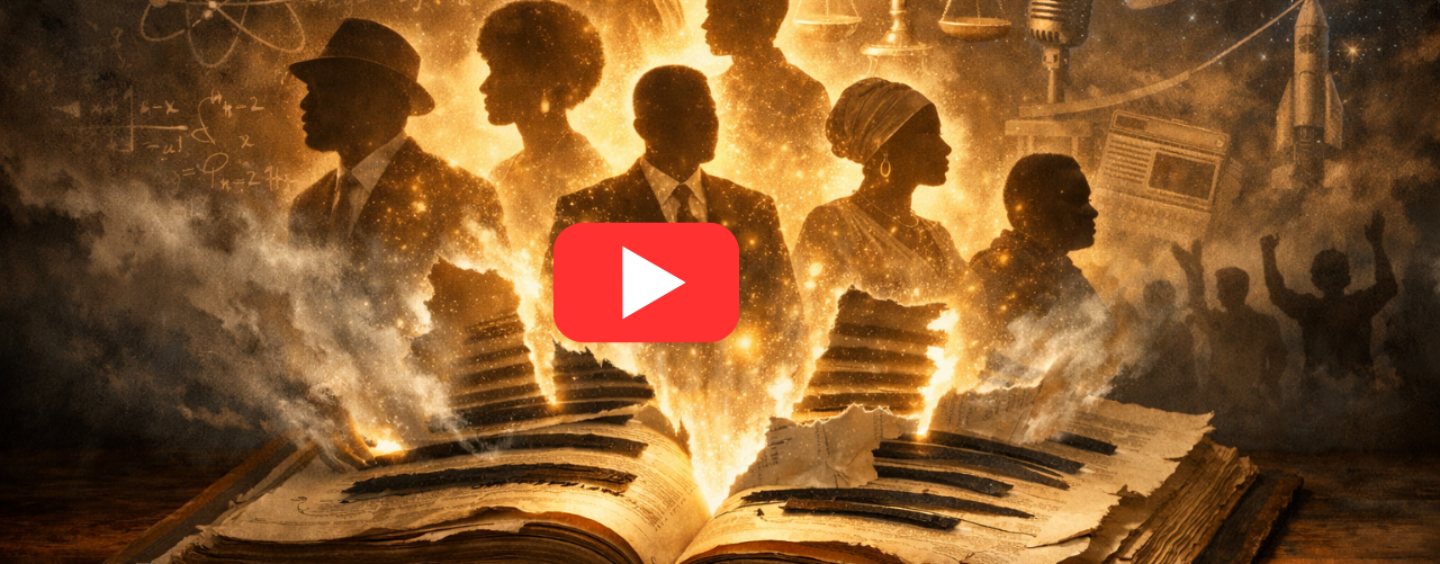
5 Black Leaders Textbooks Refused to Teach You — And Why That Erasure Still Matters

By: Peter Grear, with AI assistance
December 22, 2025
For generations, history textbooks have offered a narrow lens on Black leadership—one that often compresses centuries of struggle, innovation, and resistance into a handful of familiar names. The YouTube video “5 Black Leaders Textbooks Refused to Teach You” challenges that tradition by spotlighting influential Black figures whose contributions shaped society but were systematically omitted from mainstream curricula.
This omission is not accidental. It reflects how power decides which stories are elevated and which are silenced. By revisiting these forgotten or under-taught leaders, the video invites viewers to reconsider what they were taught—and what they were never meant to know.
The Pattern of Erasure in Black History
Most students in the United States can name Martin Luther King Jr. or Rosa Parks, but far fewer are familiar with the broader ecosystem of Black leadership that made the Civil Rights Movement, scientific breakthroughs, legal advances, and cultural transformation possible. Textbooks tend to favor figures who fit simplified narratives of progress and patriotism, while leaders who challenged economic structures, gender norms, or global power relations were often sidelined.
The video places this selective storytelling at the center of its critique. It argues that Black history has been filtered to minimize complexity and limit the public’s understanding of how deeply Black leadership influenced nearly every dimension of modern life.
Beyond the “Approved” Heroes
Although the video’s exact list of five leaders varies from traditional curricula, it follows a clear pattern: each figure represents a domain where Black excellence was undeniable, yet insufficiently acknowledged.
Some of the leaders highlighted in similar discussions include trailblazers like Dorothy Height, whose behind-the-scenes leadership helped shape major civil rights victories but rarely earned her textbook prominence. Others include scientific pioneers such as Marie Maynard Daly, the first Black woman to earn a Ph.D. in chemistry, whose research helped establish the link between cholesterol and heart disease—knowledge that has saved countless lives.
Legal history, too, is filled with overlooked Black leadership. Jane Bolin, the first Black woman judge in the United States, played a critical role in juvenile justice reform, yet her name remains absent from most standard history courses.
In media and public discourse, figures like Max Robinson, the first Black anchor of a national network news program, helped redefine representation and credibility in American journalism. Meanwhile, innovators such as Mae Jemison, the first Black woman in space, demonstrated that Black leadership extends beyond politics into science, technology, and exploration.
Each of these leaders disrupts the myth that Black achievement is rare, recent, or confined to a single sphere of influence.
Why Textbooks Left Them Out
The video implicitly asks a critical question: Why weren’t we taught this? The answer lies in how educational systems have historically functioned as tools of narrative control. Textbooks are often shaped by political pressures, funding structures, and cultural assumptions that prioritize comfort over truth.
By minimizing Black leadership outside of narrowly defined roles, curricula reinforce the idea that progress was granted rather than fought for, discovered rather than built. This selective memory also limits young people’s sense of what is possible—particularly Black youth, who may never see themselves reflected as scientists, strategists, judges, or global innovators.
The Cost of Forgetting
Erasure has consequences. When society forgets the depth of Black leadership, it becomes easier to dismiss contemporary calls for equity, reparative justice, and structural change. The video makes clear that understanding these leaders is not just about honoring the past—it’s about equipping the present.
Their stories reveal patterns of resistance, coalition-building, and innovation that remain relevant today, especially as debates rage over curriculum bans, DEI rollbacks, and whose history “belongs” in the classroom.
Reclaiming the Full Story
“5 Black Leaders Textbooks Refused to Teach You” is part of a growing digital movement reclaiming suppressed histories outside traditional institutions. Platforms like YouTube, podcasts, and independent media now serve as alternative classrooms—spaces where history can be revisited, expanded, and re-contextualized.
For initiatives like The Economic Liberation of Africa, these stories also resonate globally. They remind us that Black leadership has always been transnational, influencing economic systems, scientific knowledge, and political thought far beyond U.S. borders.
A Call to Learn—and Teach—Differently
The takeaway from this video is not simply that textbooks failed—it’s that audiences now have the power to unlearn and relearn. By seeking out the stories that were excluded, readers and viewers participate in a broader act of historical restoration.
History is not fixed. It is contested, revised, and reclaimed. And the leaders textbooks refused to teach us are central to understanding not only where we’ve been—but where we can still go.
Join the conversation—leave your take or a question.
Help grow The Economic Liberation of Africa conversation—forward to someone curious about Africa-centered opportunity.
Donate to GDN – Greater Diversity News | Subscribe – Greater Diversity News



No Comments so far
Jump into a conversationNo Comments Yet!
You can be the one to start a conversation.Only registered users can comment.