
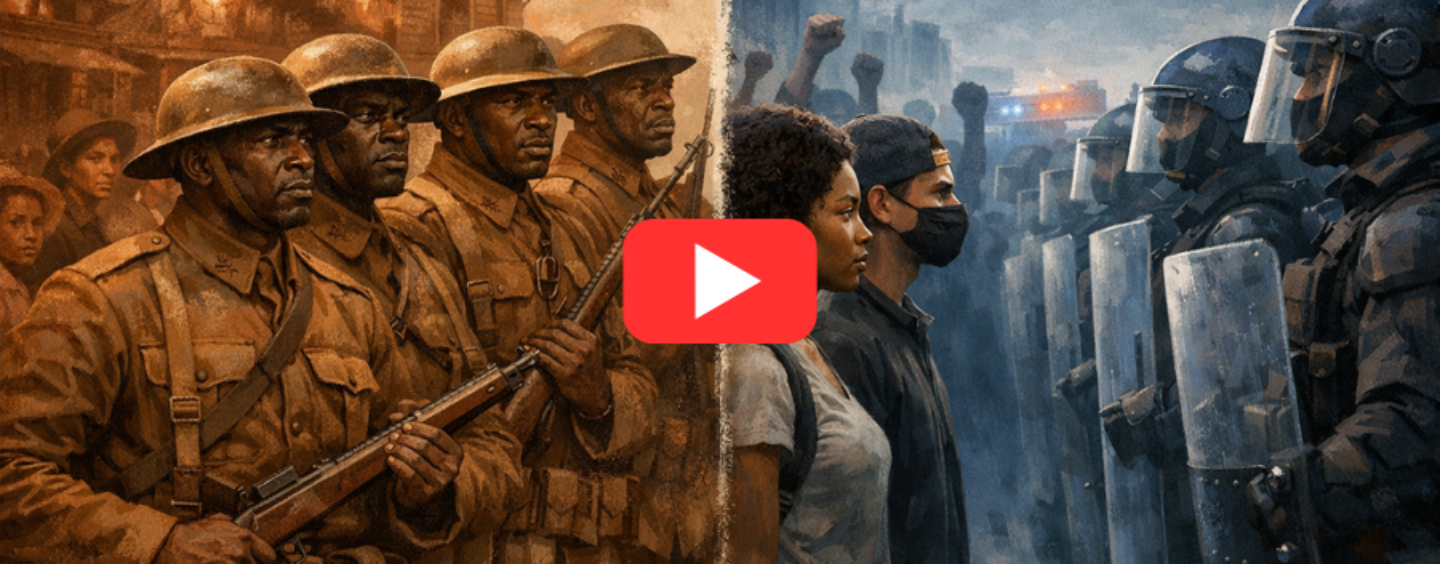
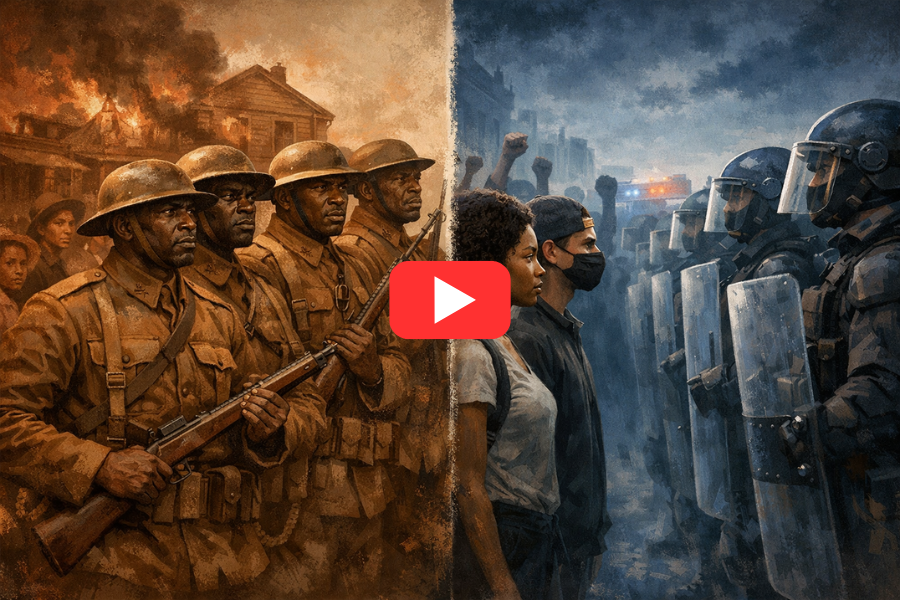
The Red Summer of 1919: When Black Resistance Met America’s First Modern Backlash
By Peter Grear, with AI assistance
December 19, 2025
In the summer of 1919, the United States erupted in one of the most violent racial reckonings in its history. Known as the Red Summer of 1919, this period saw white mobs attack Black communities across more than two dozen cities and rural areas, leaving hundreds dead and thousands displaced. The violence was not spontaneous. It was a coordinated backlash against Black progress—one that would establish a recurring pattern in American history.
The Red Summer unfolded in the aftermath of World War I, as Black Americans returned from Europe having fought for democracy abroad while being denied it at home. More than 350,000 Black veterans came back with new expectations, new skills, and a sharpened sense of citizenship. For white supremacist power structures, that combination was intolerable.
The Conditions That Sparked the Red Summer
Three forces collided in 1919. First was the Great Migration, which had already begun reshaping Northern cities. Millions of Black Southerners fled lynching, sharecropping, and Jim Crow, seeking industrial work and relative safety. Their arrival disrupted labor markets, housing patterns, and political machines long built on racial exclusion.
Second was economic anxiety. White soldiers returned to a shrinking job market as wartime production ended. Employers often exploited racial tensions by using Black workers as strikebreakers, fueling resentment that was redirected into racial violence rather than class conflict.
Third—and most decisive—was organized white supremacist backlash. Newspapers spread rumors of Black criminality and “insurrection.” Police departments either stood aside or joined the mobs. In some cities, federal employees and active-duty soldiers participated in attacks. The violence was not only tolerated; it was legitimized.
Flashpoints of Terror and Resistance
In Chicago, the murder of 17-year-old Eugene Williams for crossing an informal color line at a public beach ignited days of chaos. White mobs invaded Black neighborhoods, killing residents and burning homes. Thirty-eight people died.
In Washington, D.C., white mobs roamed the capital attacking Black residents. For the first time on a national scale, Black veterans organized armed self-defense, forcing authorities to intervene not to suppress Black people—but to stop white violence.
In Elaine, Arkansas, Black sharecroppers attempting to organize for fair wages were massacred. As many as 200 were killed after officials falsely labeled their organizing as a “Black uprising.” It remains one of the deadliest racial massacres in U.S. history.
What made the Red Summer distinct was not just the violence—but the resistance. Black communities refused to submit quietly. This period marked a shift from accommodation toward collective self-defense, political organizing, and national advocacy.
The First Modern Backlash Cycle
The Red Summer established a template that would repeat throughout American history:
- Black advancement
- White panic
- Narratives of disorder
- State-sanctioned repression
This same pattern reappeared after the Civil Rights Movement. The gains of the 1950s and 1960s were followed by mass incarceration, the war on drugs, redlining, and the rollback of voting rights—none of them accidental, all of them policy-driven.
It reappeared again after 2020, when the largest multiracial protest movement in U.S. history followed the murder of George Floyd. Calls for accountability were quickly reframed as “lawlessness.” State legislatures moved to restrict protest rights, censor racial history, and criminalize dissent. As in 1919, progress triggered punishment.
Why the Red Summer Still Matters
The Red Summer of 1919 exposes a hard truth: racial violence in the United States has often functioned as a counter-reform strategy. When Black Americans push the country closer to its stated ideals, backlash follows—not as an aberration, but as a system response.
Understanding this history clarifies today’s struggles over voting rights, policing, education, and economic equity. It reminds us that resistance has always been necessary—and that survival has often depended on organization, solidarity, and strategic clarity.
The Red Summer is not just history. It is a warning—and a guide.
Calls to Action
Donate to GDN – Greater Diversity News | Subscribe – Greater Diversity News
Join the conversation—leave your take or a question.
Help grow The Economic Liberation of Africa conversation—forward to someone curious about Africa-centered opportunity.



No Comments so far
Jump into a conversationNo Comments Yet!
You can be the one to start a conversation.Only registered users can comment.