

Beyond DEI: Why a Global Black Economy Is the Only Durable Insurance Policy
By Peter Grear (AI-assisted)
February 25, 2026
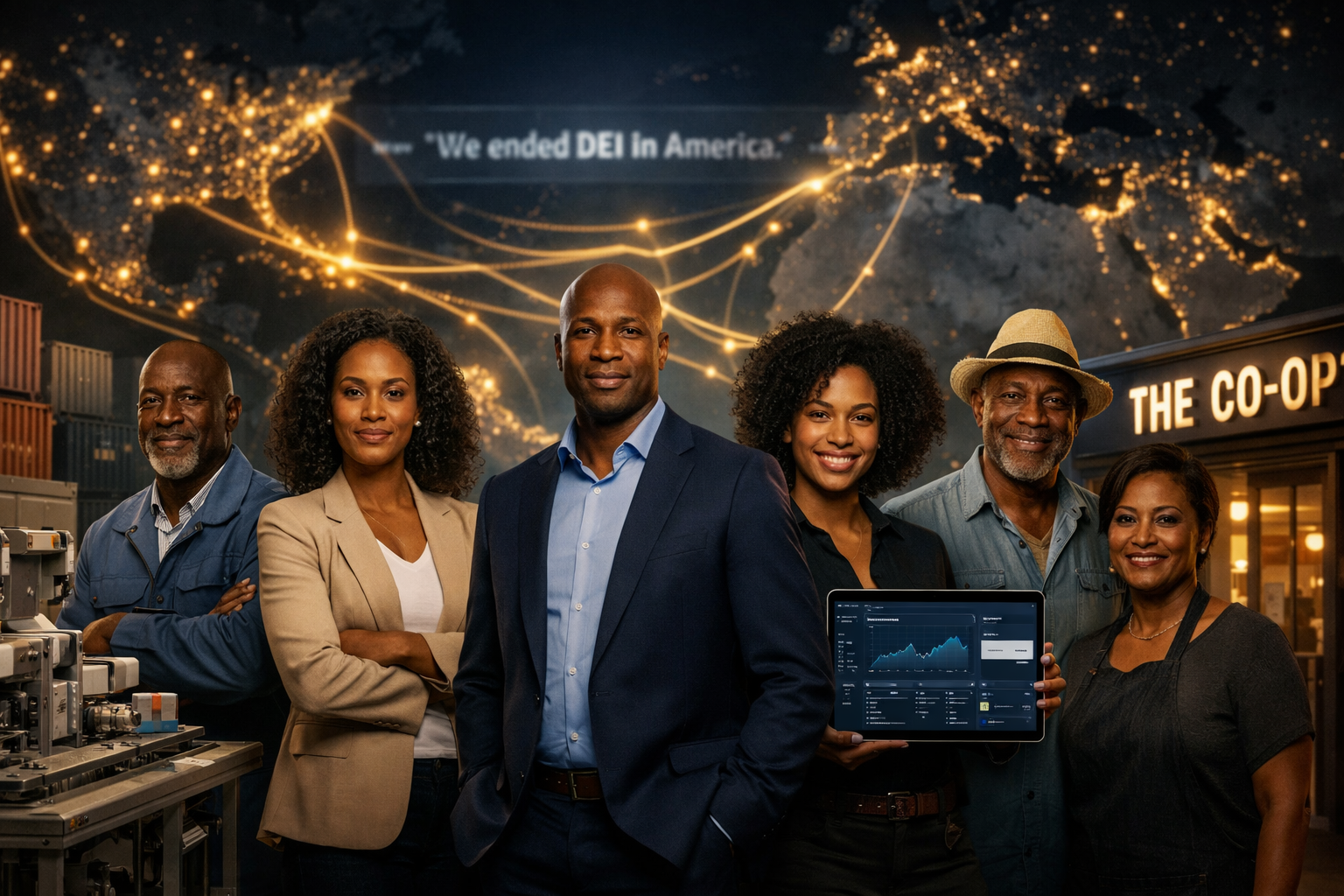
In his February 24, 2026 State of the Union address, U.S. President Donald Trump offered a line that landed like a verdict on an era: “We ended DEI in America.”
Regardless of where one stands politically, that sentence captures a reality Black communities have learned repeatedly across generations: policy-based access can expand—and it can contract. Executive priorities change. Court rulings change. Corporate risk calculations change. And when those shifts happen, communities that rely primarily on inclusion mechanisms can find themselves forced to fight the same battles again under new names.
That volatility is why an independent, globally networked Black economy is not a symbolic project. It is a strategic necessity—an economic “insurance policy” that reduces dependence on any single policy tool (including DEI) by building something harder to reverse: ownership, institutions, capital pathways, and supply chains.
This is not a call to abandon DEI. It is a call to stop treating DEI as the primary engine of Black progress. The primary engine is enterprise capacity and ownership. DEI may help people enter a system; independent economic power helps communities negotiate with it—or build around it.
Why independence matters more than access
1) Policies open doors; assets keep them open.
Representation can rise while wealth remains flat. When a community owns fewer productive assets—companies, commercial real estate, distribution networks, platforms, and finance vehicles—its gains are easier to unwind. Assets compound. Policies fluctuate.
2) Corporate priorities are cyclical; community needs are permanent.
Even well-intentioned institutions can treat equity as a brand phase: launched, funded, rebranded, then reduced when the wind shifts. A global Black economy anchors progress in institutions designed for continuity, not convenience.
3) Global strategy makes opportunity portable.
If opportunity depends on the climate of one country’s politics, it is fragile. A global economic strategy—linking Africa, the Caribbean, Europe, Latin America, and Black America—creates options: markets, investment lanes, production bases, and career mobility.
4) Ownership creates bargaining power.
The difference between inclusion and power is the ability to set terms: wages, procurement rules, investment priorities, and reinvestment commitments. When you own the platform, you don’t just ask for a seat—you influence the agenda.
What an independent global Black economy looks like
“Global Black economy” doesn’t mean a single giant institution. It means a set of repeatable systems:
- Enterprises that sell to markets (not just grants)
- Capital mechanisms that fund growth at each stage (micro → credit → expansion)
- Procurement ecosystems that route spending into Black-owned suppliers
- Durable institutions (media, trade groups, training pipelines, funds, cooperatives)
- Cross-border trade corridors connecting diaspora demand with African production and talent
Put simply: it’s the difference between being included and being economically organized.
How-to suggestions: building blocks that reduce dependency on DEI
These steps are practical and scalable—and they work best when aligned across cities and across borders.
1) Start with procurement, not inspiration.
Build a vetted supplier directory by sector (construction trades, IT services, logistics, marketing, staffing, facilities maintenance). Then recruit “anchor buyers” (churches, fraternities/sororities, alumni groups, nonprofits, municipalities, successful Black professionals) to move a portion of their purchasing toward those suppliers.
2) Build repeatable B2B pipelines (boring beats fragile).
Prioritize businesses that win contracts and scale through process: compliance support, staffing, security, bookkeeping, freight, specialized subcontracting, implementation services. These create predictable revenue, jobs, and apprenticeship ladders.
3) Create a real capital stack (and pair it with support).
Many communities fail in the “middle”: after the idea, before scale. A workable stack often looks like:
microgrants + technical assistance → revenue-based financing → credit-building + guarantees → growth capital.
Pair funding with accounting, legal structure, insurance/bonding navigation, and sales coaching.
4) Invest in shared infrastructure, not only individual success stories.
Shared back-office services, training hubs, cooperative buying groups, and export support teams reduce costs and raise survival rates across hundreds of firms—not just a handful.
5) Go global on purpose: trade corridors + credential portability.
Identify 3–5 corridors where demand and supply naturally connect (diaspora buyers + African producers; diaspora firms + African talent). Standardize credentials and portfolio-based hiring so skills travel with less friction.
6) Measure like an economy, not a campaign.
Track contract wins, supplier spend routed, retained earnings, job creation, export volume, and firm survival rates. These metrics build trust, attract partners, and keep the mission grounded.
A better frame than “DEI vs. independence”
The smartest posture is redundancy: use every tool, but depend on none. President Trump’s State of the Union line—“We ended DEI in America”—is a reminder that access strategies can be politically reversible.
But enterprise capacity is harder to repeal. A global Black economy—rooted in ownership, institutions, and cross-border networks—turns progress from a policy debate into a durable reality. That is the long game: from access to resilience.
Join the conversation—leave your take or a question.
Help grow The Economic Liberation of Africa conversation—forward to someone curious about Africa-centered opportunity.
Donate to GDN – Greater Diversity News | Subscribe – Greater Diversity News.



No Comments so far
Jump into a conversationNo Comments Yet!
You can be the one to start a conversation.Only registered users can comment.