
First Votes, Big Warnings: What the March 3 Primaries Revealed About the 2026 U.S. Midterms

By Peter Grear, with AI assistance
March 4, 2026
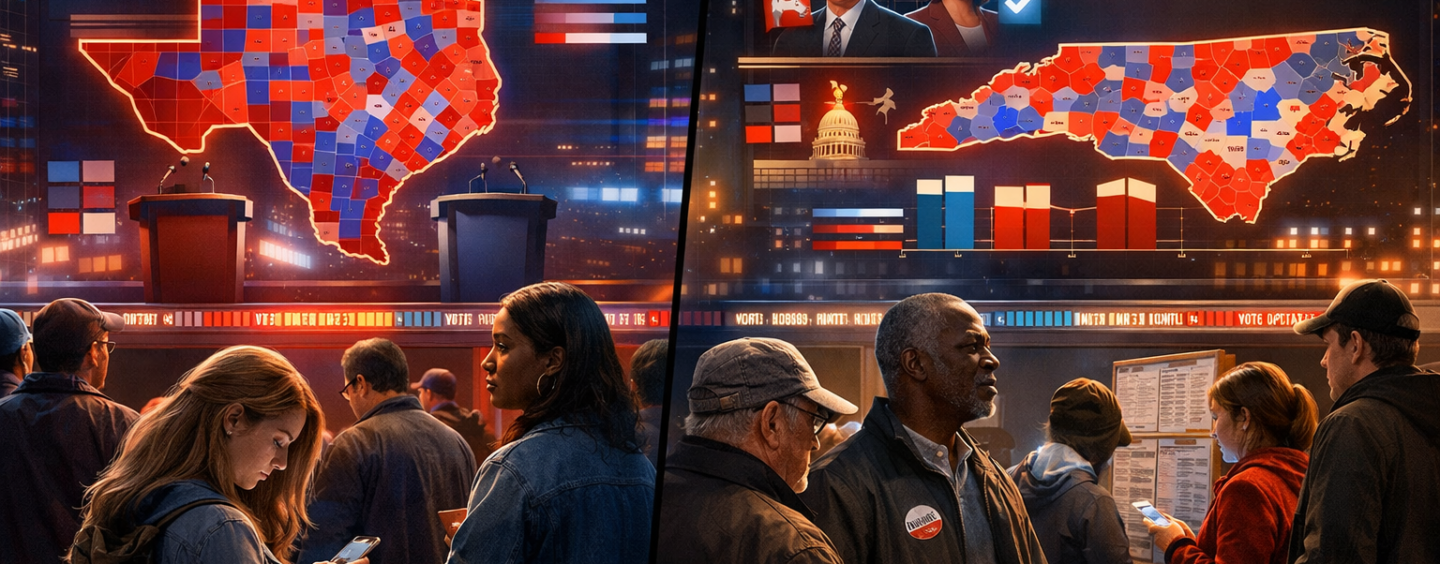
The first major elections of the 2026 cycle were not a national general election, but they still delivered an unmistakable message: the political ground is shifting early, and the biggest tremors came out of Texas and North Carolina. Tuesday’s primaries launched the midterm season with high-stakes Senate contests, a major Republican upset in Texas, and voting-rule confusion serious enough to raise fresh questions about ballot access and election administration.
In Texas, the headline was the battle for the U.S. Senate seat currently held by Republican John Cornyn. Cornyn failed to clear 50% and now heads to a May 26 runoff against Texas Attorney General Ken Paxton, creating one of the most closely watched Republican intraparty fights in the country. The result showed that even well-funded incumbents are not guaranteed safe passage through today’s GOP primaries, especially when ideological tensions are running high. Reuters reported that Cornyn led the first round, but Paxton may benefit from a more conservative runoff electorate.
On the Democratic side in Texas, State Rep. James Talarico defeated Rep. Jasmine Crockett in a closely watched and expensive Senate primary. That result matters beyond Texas. Democrats were effectively choosing between two different theories of political combat: one represented by Crockett’s sharper, more confrontational style, and the other by Talarico’s broader, faith-inflected populist message. Talarico’s victory suggests that at least in this early test, a message aimed at widening the coalition still has real appeal inside Democratic politics.
But Texas also revealed something deeper inside the Republican Party. In one of the night’s clearest upset results, Rep. Dan Crenshaw lost his primary to State Rep. Steve Toth. The Associated Press described the race as a major defeat for a Republican incumbent who had increasingly stood apart from the party’s hardest-line factions. Crenshaw’s loss signals that ideological purity tests remain powerful and that even established Republicans can be vulnerable if they are seen as insufficiently aligned with the party’s dominant base.
If Texas provided the drama, North Carolina may have produced the more nationally important matchup. Former Democratic Gov. Roy Cooper and former Republican National Committee Chairman Michael Whatley won their Senate primaries, setting up a general-election clash in one of the country’s most competitive states. Because the Senate is closely divided, North Carolina could become one of the races that helps determine control of the chamber in November. In other words, while Texas generated the noise, North Carolina may generate the real balance-of-power consequences.
Another major lesson from Tuesday was that how elections are run can become almost as important as who wins them. In Dallas and Williamson Counties, Texas, a rule change ended countywide voting and required voters to cast ballots at assigned precinct locations. That shift caused confusion, produced long lines and site-level chaos, and led to some voters being turned away. Legal battles followed, and the Texas Supreme Court ruled that ballots cast after the official closing time should be separated, leaving uncertainty around whether they would count. The episode turned election administration itself into a central political story.
Taken together, the March 3 primaries exposed three forces likely to define the rest of the 2026 cycle. First, party identity battles are far from settled, especially in Texas. Second, Senate control may run through a handful of swing-state contests, with North Carolina now firmly on that list. Third, voting rules and ballot access remain live flashpoints, capable of shaping both turnout and public confidence. Those are not secondary issues. They are now part of the main campaign narrative.
For Black voters, civic leaders, and democracy advocates, the early lesson is clear: waiting until November to pay attention would be a mistake. Primaries are increasingly where ideological direction is set, where competitive Senate fields are formed, and where election-access problems first become visible. What happened on March 3 was not the final verdict on 2026. But it was an early warning flare. The race for Congress has begun, and it is already telling a story about power, access, and the future shape of American politics.
Donate to GDN – Greater Diversity News | Subscribe – Greater Diversity News
Join the conversation—leave your take or a question.
Help grow The Economic Liberation of Africa conversation—forward to someone curious about Africa-centered opportunity.



No Comments so far
Jump into a conversationNo Comments Yet!
You can be the one to start a conversation.Only registered users can comment.