

Borderless Africa by 2050: What Full Integration Looks Like
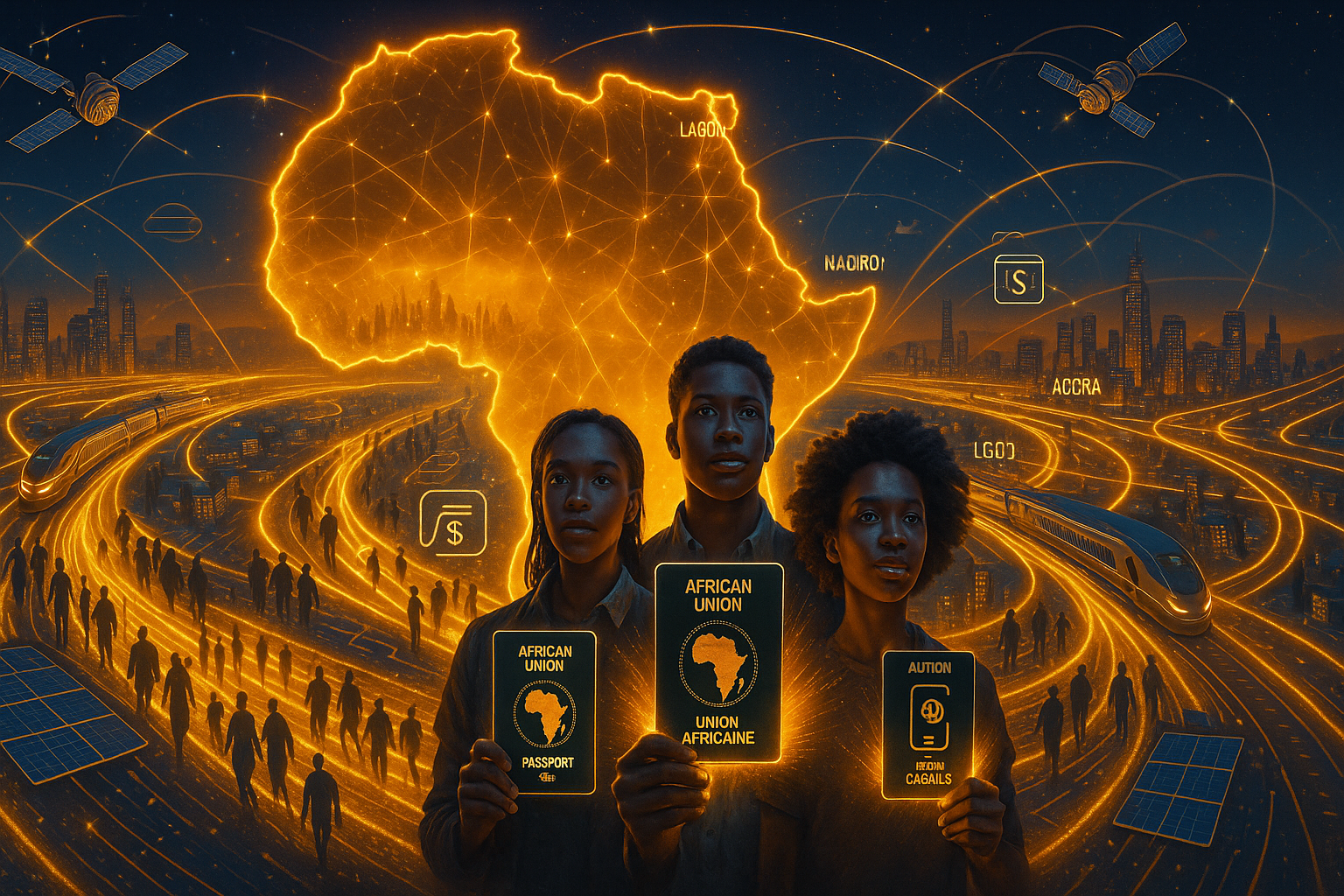
Borderless Africa by 2050: What Full Integration Looks Like
By Peter Grear, with AI assistance
September 3, 2025
Executive Snapshot: Today vs. 2050
Today (2025): AfCFTA is operational but uneven; free-movement rules are partial; AU passport is limited; intra-African trade is still a minority share; youth and diaspora energy outpaces government execution.
2050 (vision): A genuinely borderless, rules-based single market where people, goods, services, data, and capital move freely; mobility and payments are real-time; continental standards govern everything from food safety to fintech; Africa speaks with one voice on the world stage.
Economic Architecture in 2050
1) A True Single Market
- Free movement implemented across all member states: visa-free entry, mutual recognition of IDs, e-gates at borders.
- Regulatory convergence: a standardized continental code for customs, product standards, competition policy, consumer protection, and data flows.
- Professional portability: engineers, nurses, lawyers, and teachers practice across borders via continent-wide credential recognition.
2) Trade, Industry & Supply Chains
- Intra-African trade >50% of total (vs. ~15–20% today), driven by regional value chains in food processing, textiles, EVs, green hydrogen, batteries, and pharmaceuticals.
- Special economic corridors (ports–rail–dry ports–industrial parks) stitch together West, East, Central, North, and Southern Africa, cutting logistics times by half.
- Rules-of-origin simplicity: one digital certificate accepted continent-wide reduces compliance friction for SMEs.
3) Finance, Payments & Investment
- Instant cross-border retail and wholesale payments via a continent-wide real-time settlement rail; low fees empower small merchants and creators.
- Pan-African listings & capital pools: integrated stock markets, pension funds, and insurance capital finance continental infrastructure and high-growth firms.
- Diaspora finance mainstreamed: liquid diaspora bonds and crowd-equity platforms channel billions annually into African ventures.
- RoFR embedded: Right of First Refusal provisions steer strategic contracts first to qualified African and diaspora firms before extra-continental bidders.
4) Energy & Digital Backbones
- Interconnected power pools stabilize supply and accelerate renewables; cross-border wheeling makes energy tradable like data.
- Pan-African cloud & data centers: localized compute plus secure data-governance standards keep value—and privacy—on the continent.
- 5G/6G coverage and dark-fiber spines enable remote work exports and AI-enabled services from any region.
Social Fabric in 2050
1) Pan-African Citizenship, Tangibly Felt
- Universal AU passport accepted for work, study, and residence; straightforward digital residency permits.
- Social portability: health insurance, social-security credits, and academic transcripts follow citizens across borders via secure digital IDs.
2) Cities, Culture & Talent Mobility
- Cross-border megaregions (e.g., Abidjan–Accra–Lagos; Nairobi–Kampala–Kigali) operate as integrated labor and consumer markets.
- Creative economy scale-up: a common IP framework powers continental streaming, gaming, Nollywood-plus, music touring circuits, and sports leagues.
- Education ladders: shared K-12 curricular competencies and university credit recognition let students stack micro-credentials anywhere in Africa.
3) Inclusion as Design Principle
- Youth pathways: continental apprenticeships and startup visas reduce brain drain by turning mobility into opportunity at home.
- Gender equity mainstreamed in procurement, financing, and land titling; childcare and eldercare sectors formalized to unlock labor participation.
- Rural inclusion: digital extension services, e-commerce logistics, and mobile finance shrink the urban–rural opportunity gap.
Geopolitics & Security in 2050
1) One Voice, Many Levers
- Coordinated external policy: unified negotiating positions in trade, climate, finance, and tech standards; Africa is a rule-maker, not rule-taker.
- Strategic autonomy: diversified partners, African-owned satellites and undersea cables, and homegrown defense and cyber capabilities.
2) Peace, Security & Justice
- Interoperable policing and courts: joint task forces counter trafficking, wildlife crime, illicit finance, and cyber threats; e-extradition and shared evidence chains speed justice.
- Climate security compacts: basin-wide water management (Nile, Congo, Niger), drought insurance pools, and resilient agriculture reduce conflict triggers.
3) Food & Health Sovereignty
- Continental food reserve and grain exchanges stabilize prices; climate-smart agriculture networks lift yields.
- African CDC 2.0 coordinates stockpiles, genomic surveillance, and IP-sharing for vaccines and therapeutics.
Governance That Makes It Work
- Free-movement protocol codified in national law with standardized enforcement.
- Pan-African Procurement Code: transparent e-tenders, open-contracting data, integrity pacts, and RoFR guardrails.
- Data & AI Charter: privacy, portability, algorithmic accountability, and cross-border data adequacy rules.
- Fiscal solidarity: formula-based funds help smaller or landlocked states adapt, preventing “winner-takes-all” integration.
- Municipal diplomacy: empowered city networks coordinate transit, housing, and climate action across borders.
Risks—and the Guardrails
Risks: uneven gains between hubs and peripheries, migration surges stressing services, cross-border crime, digital monopolies, policy reversals.
Guardrails:
- Minimum social floor (basic healthcare, education, digital access) guaranteed continent-wide.
- Revenue-sharing and transition funds for lagging regions.
- Competition policy to curb oligopolies and ensure open platforms.
- Independent dispute bodies with binding timelines for trade and movement cases.
- Civic transparency: open data on border performance, logistics times,



No Comments so far
Jump into a conversationNo Comments Yet!
You can be the one to start a conversation.Only registered users can comment.