
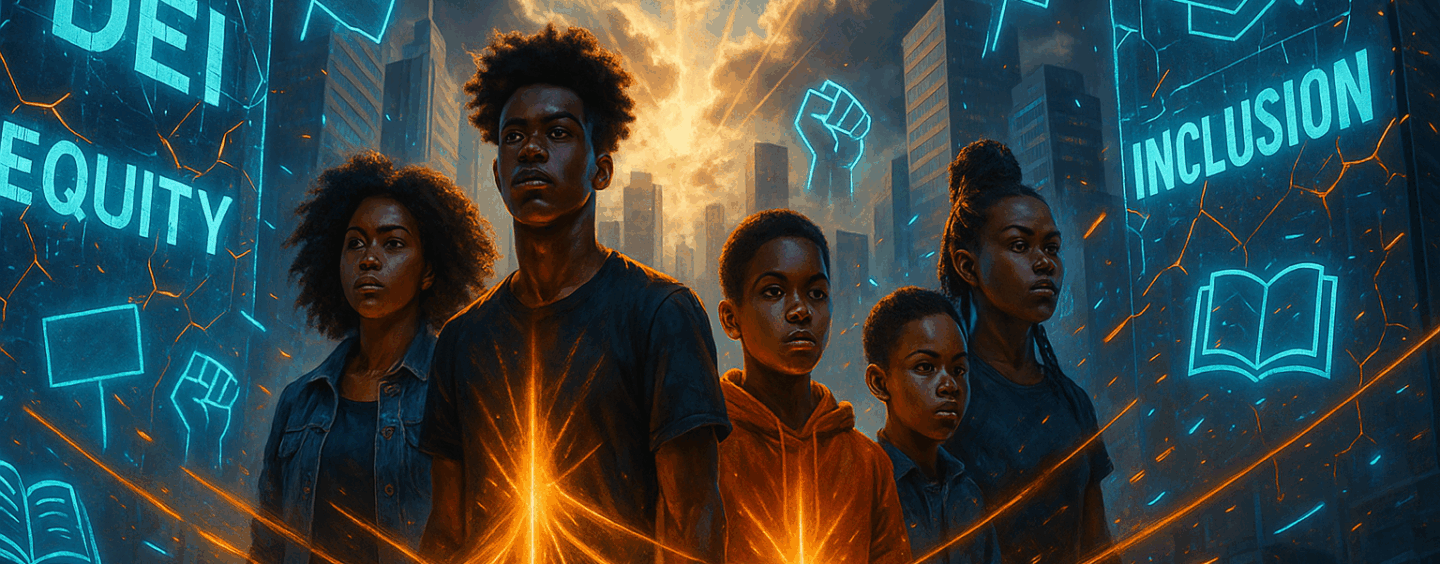
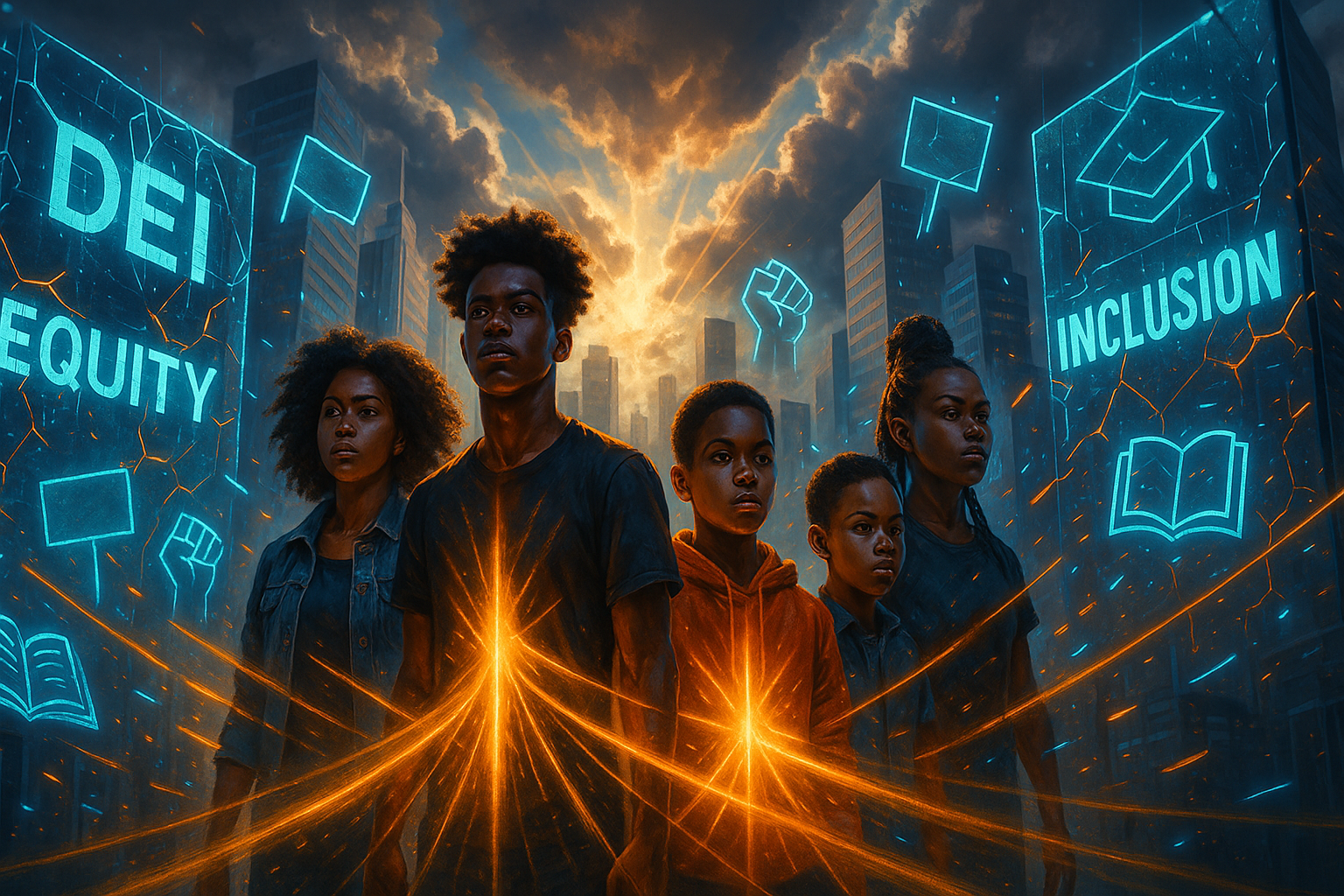
How Attacks on DEI Are Radicalizing a New Generation of Black Youth
By Peter Grear with AI Assistance
Publication Date: December 13, 2025
For more than half a century, Diversity, Equity, and Inclusion (DEI) programs have served as on-ramps for Black advancement across education, business, media, and public life. But today DEI is under the most coordinated attack in its history. From federal efforts to strip DEI funding, to state-level bans in universities, to corporate rollbacks that quietly erase equity commitments, America is witnessing a sweeping retreat from the promises that emerged out of the Civil Rights Movement.
Yet something unexpected is happening: instead of discouraging Black youth, these attacks are radicalizing a new generation, sharpening their political consciousness and pushing them to organize in ways reminiscent of their grandparents’ battles against segregation and Jim Crow. In a moment when institutions are pulling back, young Black people are pushing forward—building new spaces, movements, and educational frameworks that no longer rely on acceptance from the mainstream.
The DEI Retrenchment: A Modern Form of Erasure
At its core, the DEI backlash is not simply about administrative guidelines or hiring practices. It is a political and cultural project aimed at restricting conversations about race, discrediting Black history, and rolling back access to opportunity. Corporate DEI departments have been dissolved. Universities have ended cultural centers and student programs. Policymakers have targeted books, language, and courses that explain structural racism.
For Black youth, the message is unmistakable: the institutions they were told to trust are willing to erase them if doing so is politically useful. The psychological impact is profound. When a society denies your experiences and dismantles the tools designed to ensure fairness, young people begin to question the system itself—not just its policies.
A Generation That Refuses Silence
Instead of withdrawing, Black youth are responding with a clarity and urgency that signals a historic shift. They are rediscovering the radical traditions of earlier movements—the abolitionist schools of Reconstruction, the independent student organizing of the 1960s, and the Black Power emphasis on self-determination.
Several youth-driven organizations reflect this trend.
Black Youth Project 100 (BYP100) trains young organizers in political education, direct action, and structural critique, operating from a Black queer feminist lens. Their work goes far beyond diversity language, demanding deep transformation in policing, economic justice, and community power.
In Chicago, Assata’s Daughters cultivates a pipeline of Black girl and gender-expansive youth activists grounded in liberation theory and local organizing. Their programs help youth understand not only the failures of current systems but also the possibilities for community-built alternatives.
Across the country, informal but powerful networks of young content creators, cultural critics, and citizen journalists use platforms like TikTok, YouTube, and Instagram to expose inequities, amplify local struggles, and explain the broader political agenda behind DEI rollbacks. These creators are shaping the narrative for millions, generating a new ecosystem of Black digital intellectualism.
The Rise of Alternative Education Models
With schools and universities limiting what students can learn about race, young people are turning to community-based educational spaces that operate outside the traditional system. These include radical freedom schools, mutual-aid study groups, and youth-led liberation classes that blend history, civics, media literacy, and movement strategy. Many explicitly link the DEI attacks to the long legacy of state-sponsored racism—from plantation medicine and redlining to mass incarceration and voter suppression.
In these spaces, Black youth are not passive recipients of knowledge—they are co-creators. They analyze, debate, challenge, and build. They connect the past to the present. They treat learning as a pathway to liberation, not just employment.
Radicalization as Empowerment, Not Extremism
“Radicalization” is often framed negatively, but in this context it reflects something powerful: a generation refusing to accept a diluted version of equality. Black youth are turning toward structural critique because lived reality has shown them that reforms can be rolled back the moment power shifts. Rather than waiting for institutions to recognize their humanity, they are constructing ecosystems of empowerment—rooted in culture, history, analysis, and collective self-determination.
The attacks on DEI may have been designed to silence racial justice work. Instead, they have sharpened a generation’s understanding of what justice truly requires.
This new youth movement is not asking to be included at the table. They are building a new one.
CALL TO ACTION
Donate to GDN – Greater Diversity News | Subscribe – Greater Diversity News
Join the conversation—leave your take or a question.
Help grow The Economic Liberation of Africa conversation—forward this to someone curious about Africa-centered opportunity.



No Comments so far
Jump into a conversationNo Comments Yet!
You can be the one to start a conversation.Only registered users can comment.