
“No Kings”: What October 18 Revealed—And How Black Leadership Shaped the Day
By Peter Grear, with AI assistance
October 20, 2025
On October 18, the “No Kings” actions spilled across the United States in one of the largest, most geographically widespread protest mobilizations in recent memory. From New York City to Los Angeles, from Washington, D.C., to Houston and Chicago, crowds gathered to assert a simple founding-era principle: America has no kings. Participants framed the day as a collective stand against perceived authoritarian overreach, raising alarms about civil liberties, the independence of institutions, reproductive and LGBTQ+ rights, and the basic guardrails of democratic life.
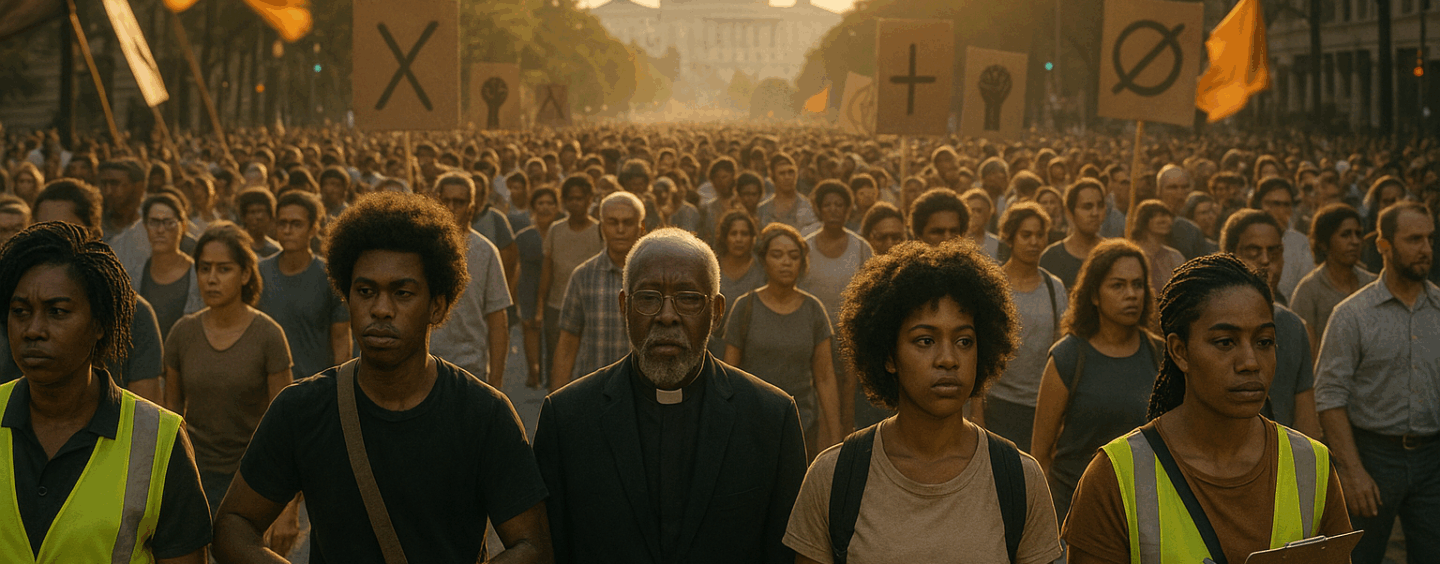
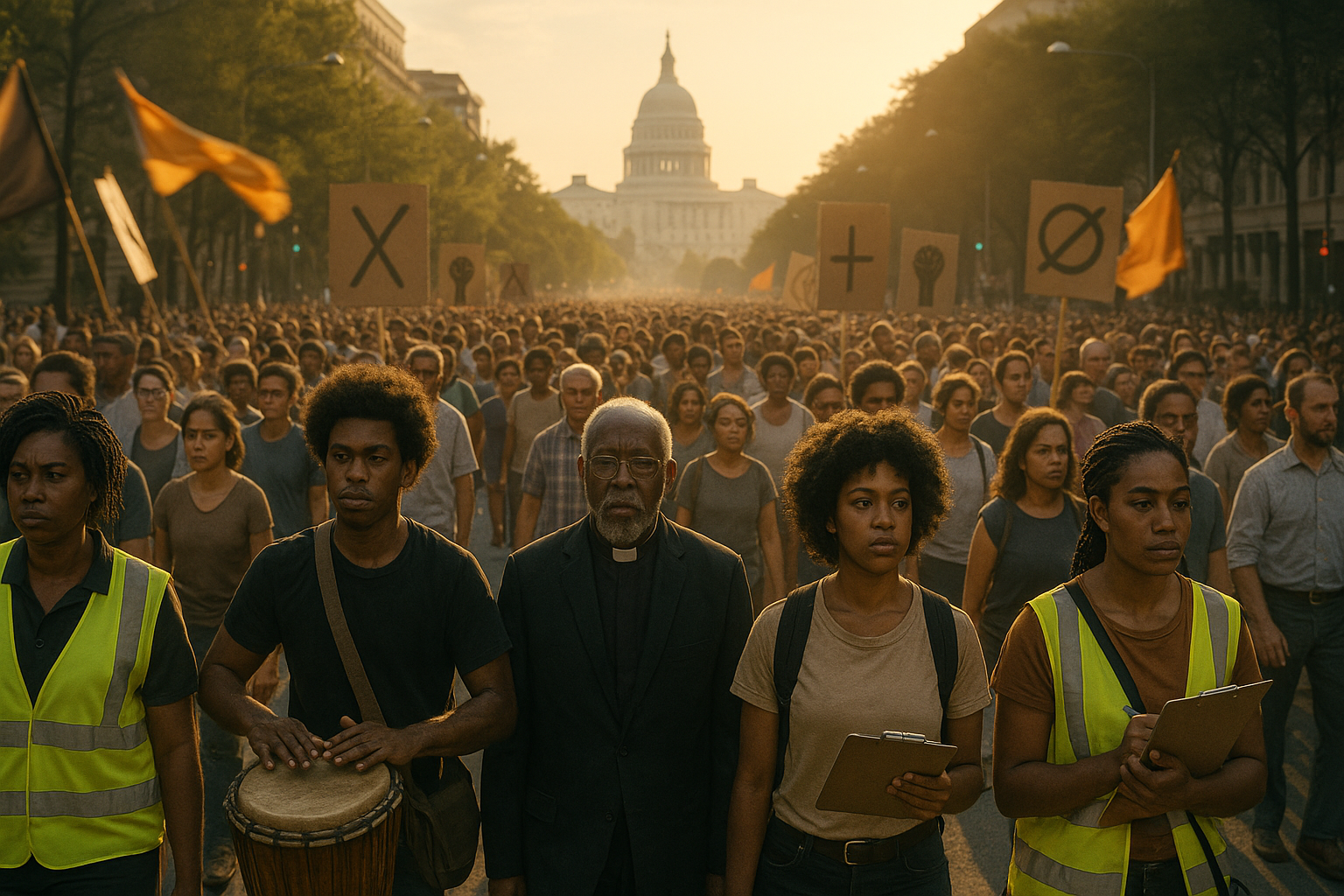
What distinguished the mobilization was less a single, centralized march than a distributed map of civic energy. Organizers and local coalitions anchored thousands of events—city plazas, neighborhood corridors, university quads, and church parking lots—knitting together a national tapestry of peaceful rallies. The tone was determined, creative, and overwhelmingly nonviolent: giant hand-painted banners, colonial-era symbolism reimagined for 2025, and human-formed letters spelling out messages that echoed across drone shots and street-level photos. While law enforcement maintained a visible presence in many cities, reports of serious unrest were scarce compared to the size and scope of the day.
The “No Kings” theme carried particular resonance in historically Black communities and civic spaces, where the protest’s core message aligned with long-standing struggles over dignity, equal protection, and accountable government. In Atlanta, speakers invoked a civil-rights lineage that runs from the King era to today’s voting-rights battles. In Washington, D.C., marchers moved through the U Street corridor—ground long associated with Black culture and political organizing—before joining larger crowds on the National Mall. Chicago’s gathering featured high-profile remarks and visible contingents from the South and West Sides, reflecting the city’s deep bench of faith, labor, and neighborhood leadership. In New Orleans, culture bearers and musicians turned a rally into a civic performance, underscoring how Black artistry often operates as both drumbeat and blueprint for social change.
Black participation wasn’t limited to turnout; it was evident on stages, in logistics, and in the narrative framing of the day. Black elected officials and organizers helped anchor messages about rule of law, voting protections, and community safety. Black-led groups—ranging from neighborhood associations to national civic organizations—played visible roles in turnout, volunteer management, and program curation. Black-owned and Black-serving media documented the events in real time, preserving the texture often missed by quick national roundups: the chant call-and-response, the home-printed signs, the elders standing beside first-time voters, and the student marshals guiding foot traffic with calm authority.
Several moments stood out. In multiple cities, speakers connected the “No Kings” refrain to concrete civic actions—registering voters, observing polls, preparing for court challenges, and defending local libraries and school boards from ideological capture. The linkage matters: mass protest without a pipeline to durable action rarely outlives the news cycle. October 18 showed signs of an emerging pipeline—QR codes on placards, sign-up kiosks beside sound stages, and scheduling boards that directed attendees to the next week’s canvass or teach-in.
The scale, distribution, and discipline of the day also carried a message for policymakers and candidates. For those who see public discontent as background noise, October 18 was an audible alarm clock. For those who fear that civic energy is too fragmented to matter, the events offered a different story: local specificity feeding national coherence. That coherence was strengthened by Black leadership—elected, civic, cultural—whose presence signaled both continuity with the civil-rights tradition and an insistence on democratic modernization: secure ballot access, transparent governance, and communities that can hold power to account.
Critics will ask whether a slogan like “No Kings” can translate into policy wins. The answer depends on whether coalitions keep doing what many did on October 18: connect the moral case to an actionable checklist. Protect independent courts and honest counting. Fund local watchdog journalism. Safeguard school curricula from historical erasure. Expand civic apprenticeships for teens and first-time voters. When those items are resourced—and when the communities that disproportionately shoulder democratic backsliding are centered in the work—protest transforms from a single day into a season of results.
For readers of The Economic Liberation of Africa, there’s an additional lens. Movements that defend democratic norms at home tend to sharpen our credibility abroad—especially in African markets and diasporan networks watching how the United States handles pluralism, accountability, and the rule of law. The same inclusive values that widen the franchise domestically also underpin responsible partnership internationally. October 18, viewed this way, wasn’t only a domestic protest; it was a statement about what kind of partner America intends to be.
What’s next: If October 18 was the ignition, the test is whether organizers can maintain momentum in the unglamorous days after. That means data hygiene for volunteer lists, weekly touchpoints, policy education that meets people where they are, and hyperlocal wins that restore faith that civic work still moves the needle. Black leadership and Black institutions—churches, HBCUs, neighborhood nonprofits, local media—are positioned to remain pivotal, translating street-level legitimacy into durable civic infrastructure.
Join the conversation—leave your take or a question.
Help grow The Economic Liberation of Africa conversation—forward to someone curious about Africa-centered opportunity.
If our coverage adds value, please consider donating to support Greater Diversity News and The Economic Liberation of Africa so we can expand reporting, training, and student fellowships.



No Comments so far
Jump into a conversationNo Comments Yet!
You can be the one to start a conversation.Only registered users can comment.