
North Carolina Supreme Court vacates nine years of Leandro school funding orders
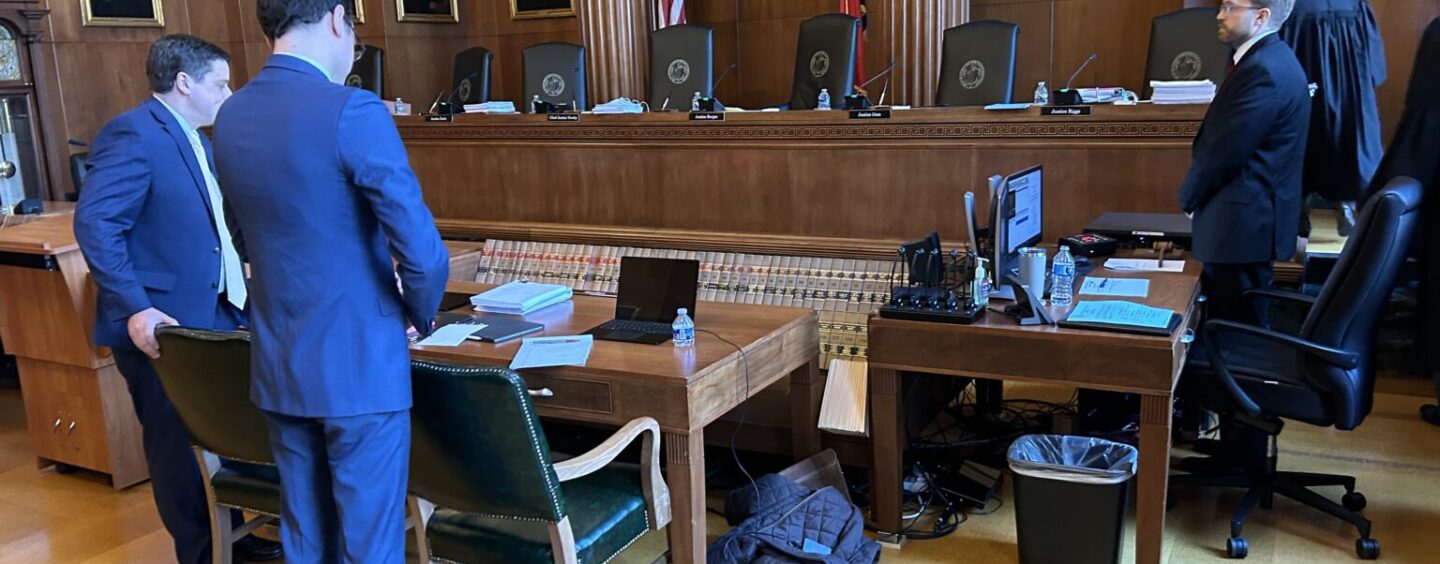
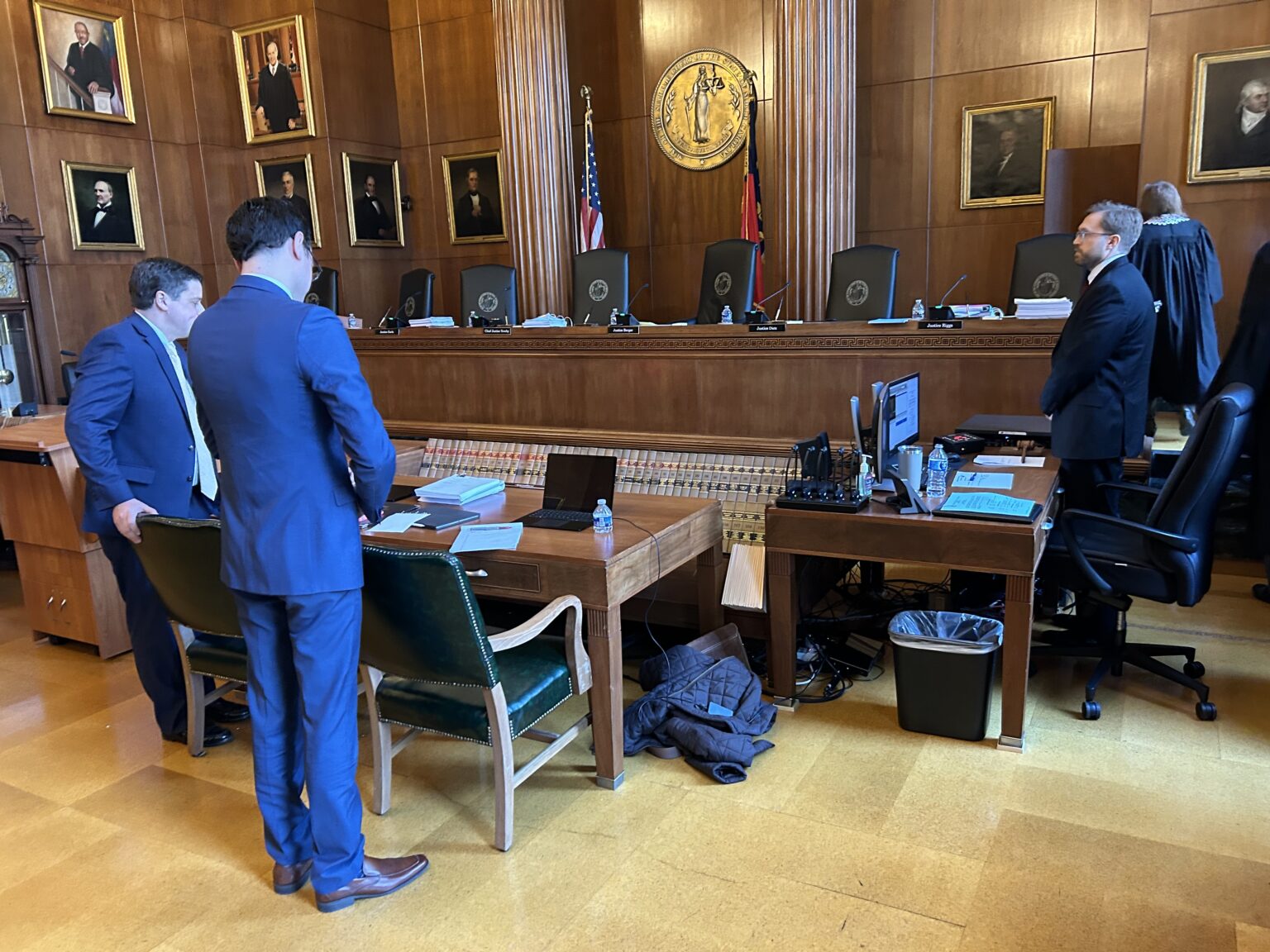 Attorneys and court staff stand during Leandro hearing. (Photo: Greg Childress/NC Newsline)
By Ahmed Jallow, NC Newsline
April 2, 2026
Republished by GDN April 3, 2026
The North Carolina Supreme Court on Thursday threw out years of court rulings in the state’s long-running Leandro education case, declaring that the judges who made them lacked the authority to order sweeping statewide school funding changes.
The court issued its 244-page ruling more than two years after hearing oral arguments in February 2024. The ruling was 4–3, with Republican Richard Dietz and Democrats Anita Earls and Allison Riggs dissenting.
The decision vacates a 2023 trial court order requiring the state to transfer hundreds of millions for education improvements, and nullifies a Supreme Court ruling that confirmed the trial court’s authority to do so.
“The trial court lacked jurisdiction to enter the order,” Republican Chief Justice Paul Newby wrote for the majority, concluding that the case had expanded beyond the claims originally brought before it. The justices said orders issued after the case became a broader statewide challenge in 2017 are “void.”
The Leandro case dates back to 1994, when five low-wealth, rural counties sued the state over insufficient school funding. In 1997, the North Carolina Supreme Court ruled that the state was violating students’ constitutional right to a sound, basic education, a decision that has been upheld multiple times since.
In her dissent, Earls wrote, “The current Court appears unable or unwilling to meaningfully check constitutional rights violations—particularly those originating from the legislature.”
Delays in Leandro case are hurting students, advocates tell N.C. Supreme Court
Thursday’s ruling halts, at least for now, court-ordered efforts to force state officials to implement a long-debated plan to improve public schools, returning control over education funding decisions to the General Assembly.
Legislators have for years resisted the spending increases court decisions have called for. Democrats controlled the legislature until 2011, but did not provide the funding needed to solve the problem. In recent years, Republicans have similarly declined to appropriate the full amount called for by a remedial plan that had been agreed to by the state, the plaintiffs and a judge.
The most recent substantive ruling came in November 2022, when the court ordered the General Assembly to fund the first two years of the Comprehensive Remedial Plan. After the court shifted to a 5-2 Republican majority in 2023, the justices granted Republican lawmakers’ request to reconsider that decision.
Republican lawmakers have argued that the state constitution gives the legislature alone the power to decide how taxpayer money is spent, and that courts lack the authority to tell them how to spend it.
The court’s decision does not overturn the constitutional right to a sound basic education, but it removes the court orders designed to enforce it.
Help us produce more stories like this.
As a nonprofit newsroom, our articles are free for everyone to access. Readers like you make that possible. Can you help sustain our watchdog reporting today?
NC Newsline is part of States Newsroom, a nonprofit news network supported by grants and a coalition of donors as a 501c(3) public charity. NC Newsline maintains editorial independence. Contact Editor Laura Leslie for questions: [email protected].



No Comments so far
Jump into a conversationNo Comments Yet!
You can be the one to start a conversation.Only registered users can comment.