
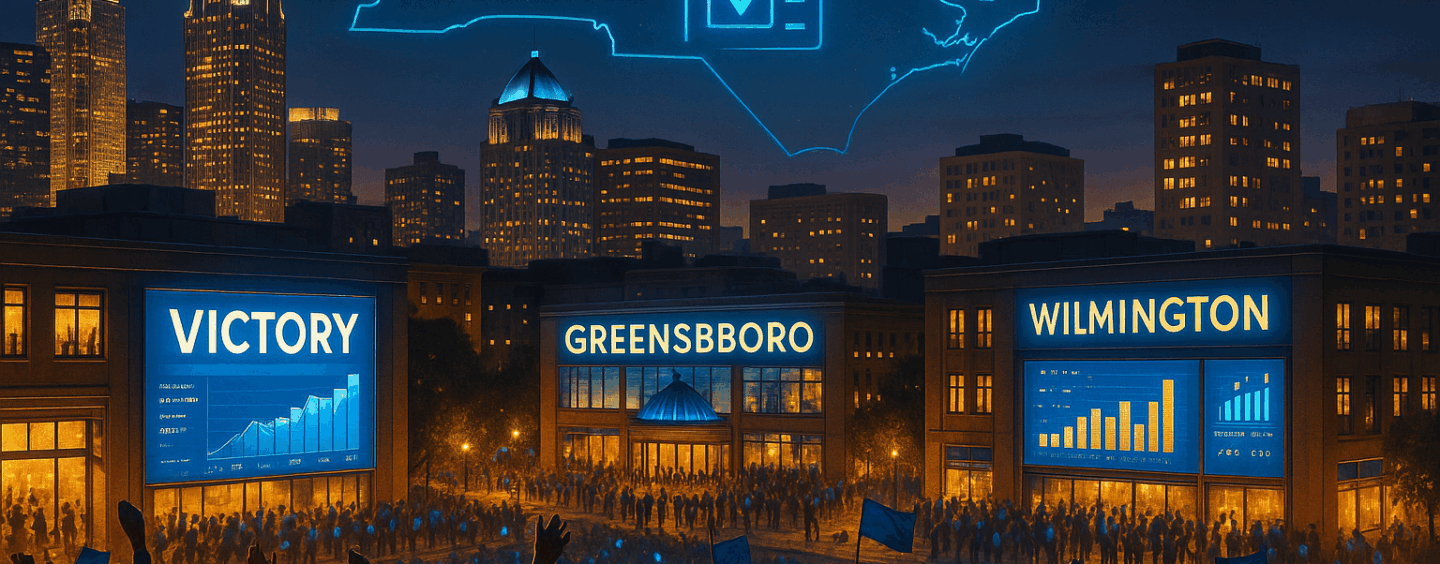
North Carolina’s 2025 Municipal Elections: A Blue Surge Signals Shifting Ground for 2026
By Peter Grear, with AI assistance
Published: November 14, 2025
North Carolina’s November 2025 municipal elections revealed a clear message from the state’s voters: Democrats are consolidating their strength in the state’s urban and suburban centers, while Republicans face growing challenges in maintaining their influence outside of rural areas. Though no statewide or federal offices were on the ballot, the results across key cities — Charlotte, Wilmington, Greensboro, and others — serve as a bellwether for the political and demographic realignments shaping the future of North Carolina politics.
The Big Picture: Democrats Dominate Local Races
Across more than 550 municipalities, Democratic candidates enjoyed one of their strongest municipal showings in over a decade. In Charlotte, incumbent Democratic Mayor Vi Lyles secured re-election with roughly 70% of the vote, reaffirming the city’s position as a Democratic stronghold. Her victory wasn’t isolated — Democrats swept all four at-large city council seats, with Dimple Ajmera, Victoria Watlington, James “Smuggie” Mitchell, and LaWana Slack-Mayfield capturing the top spots.
Charlotte voters also approved a 1-cent sales tax increase to fund transit and infrastructure projects projected to generate nearly $19 billion over 30 years. The measure’s success demonstrated voter confidence in Democratic leadership and the city’s appetite for bold, growth-oriented policy.
Further east, Wilmington told a similar story. Incumbent Democratic Mayor Bill Saffo won his 10th term with nearly half the vote, defeating Republican challenger Billy Craig. Democrats also swept all three city council seats, marking the second consecutive election where Republicans failed to secure any representation in Wilmington’s city government. The result underscores a continuing Democratic surge in coastal North Carolina — historically a more politically mixed region.
In Greensboro, Democratic-aligned candidate Marikay Abuzuaiter captured the mayor’s seat with over 60% of the vote, while Democrats retained a commanding presence on the city council. Guilford County, which includes Greensboro, once again affirmed its status as a key pillar of the state’s Democratic coalition.
Meanwhile, in the western city of Asheville and its surrounding Buncombe County towns, progressive and Democratic-aligned candidates continued to perform strongly. Even in smaller municipalities such as Weaverville and Woodfin, the election of candidates with pro-environment and pro-worker platforms reflected a broader appetite for governance rooted in equity, sustainability, and inclusivity.
What the Numbers Suggest
The 2025 municipal results reveal three major trends:
- Urban Consolidation of Democratic Power: Cities such as Charlotte, Durham, Raleigh, Greensboro, and Wilmington now form an unbroken corridor of Democratic dominance. This growing urban base gives Democrats a strong foundation for future statewide campaigns.
- Suburban Drift: Suburban zones that once leaned Republican — especially around Mecklenburg, Wake, and New Hanover counties — show steady Democratic growth. Voters in these areas appear motivated by infrastructure investment, public education, and quality-of-life issues rather than partisan loyalty.
- Republican Rural Reliance: The GOP continues to perform strongly in rural areas, but its municipal reach is narrowing. With the North Carolina General Assembly still under Republican control, the contrast between state and local governance highlights a widening political divide — urban Democratic cities versus rural Republican legislatures.
Why These Local Races Matter
Municipal elections might seem minor, but they are the laboratories of party infrastructure. Mayors, council members, and city commissioners often form the backbone of future statewide campaigns. For Democrats, 2025’s victories mean a growing bench of experienced, electable candidates who can challenge Republican dominance in future legislative and congressional contests.
Moreover, local Democratic control directly impacts governance. Policies on housing, zoning, police oversight, and economic inclusion are decided at the city level. The success of measures like Charlotte’s transit tax and progressive urban initiatives signals voter confidence in Democratic management of practical, bread-and-butter issues.
Republicans, however, retain substantial institutional power through state-level dominance. The GOP continues to control the North Carolina legislature and uses its authority to shape district maps, allocate funds, and define education and voting policy. Yet, the municipal outcomes show a potential warning: urban and suburban shifts could eventually erode the foundation of that statewide advantage.
What It Means for 2026 and Beyond
The 2025 municipal cycle positions North Carolina as a pivotal state to watch heading into the 2026 midterms. If Democrats can maintain their urban momentum and expand outreach into the suburban crescent between Charlotte, Raleigh, and the coast, they could reshape the state’s political map over the next five years.
For Republicans, the results serve as both a warning and an opportunity. The party still enjoys strong loyalty in rural communities, but it faces growing pressure to modernize its messaging — particularly around economic mobility, diversity, and infrastructure. The party’s performance in cities like Charlotte and Wilmington indicates that appeals focused solely on cultural grievances are falling flat with urban and suburban voters concerned with everyday economics.
A Turning Point for North Carolina Politics
North Carolina’s 2025 municipal elections highlight the state’s evolving political identity — one defined by diversity, economic ambition, and generational change. As one political analyst noted, “These local results aren’t just about potholes and parks; they’re about who defines the vision of North Carolina’s future.”
The road to 2026 will test whether Democrats can translate local victories into statewide gains, and whether Republicans can retool their message to remain competitive in a rapidly changing electorate. For now, the evidence from Charlotte to Wilmington points to a clear trend: North Carolina’s cities are turning bluer, and the map of tomorrow’s politics may already be taking shape.
Donate to GDN – Greater Diversity News | Subscribe – Greater Diversity News
Join the conversation—leave your take or a question.
Help grow The Economic Liberation of Africa conversation—forward to someone curious about Africa-centered opportunity.



No Comments so far
Jump into a conversationNo Comments Yet!
You can be the one to start a conversation.Only registered users can comment.