

The Promise and Challenges of the African Continental Free Trade Area (AfCFTA)
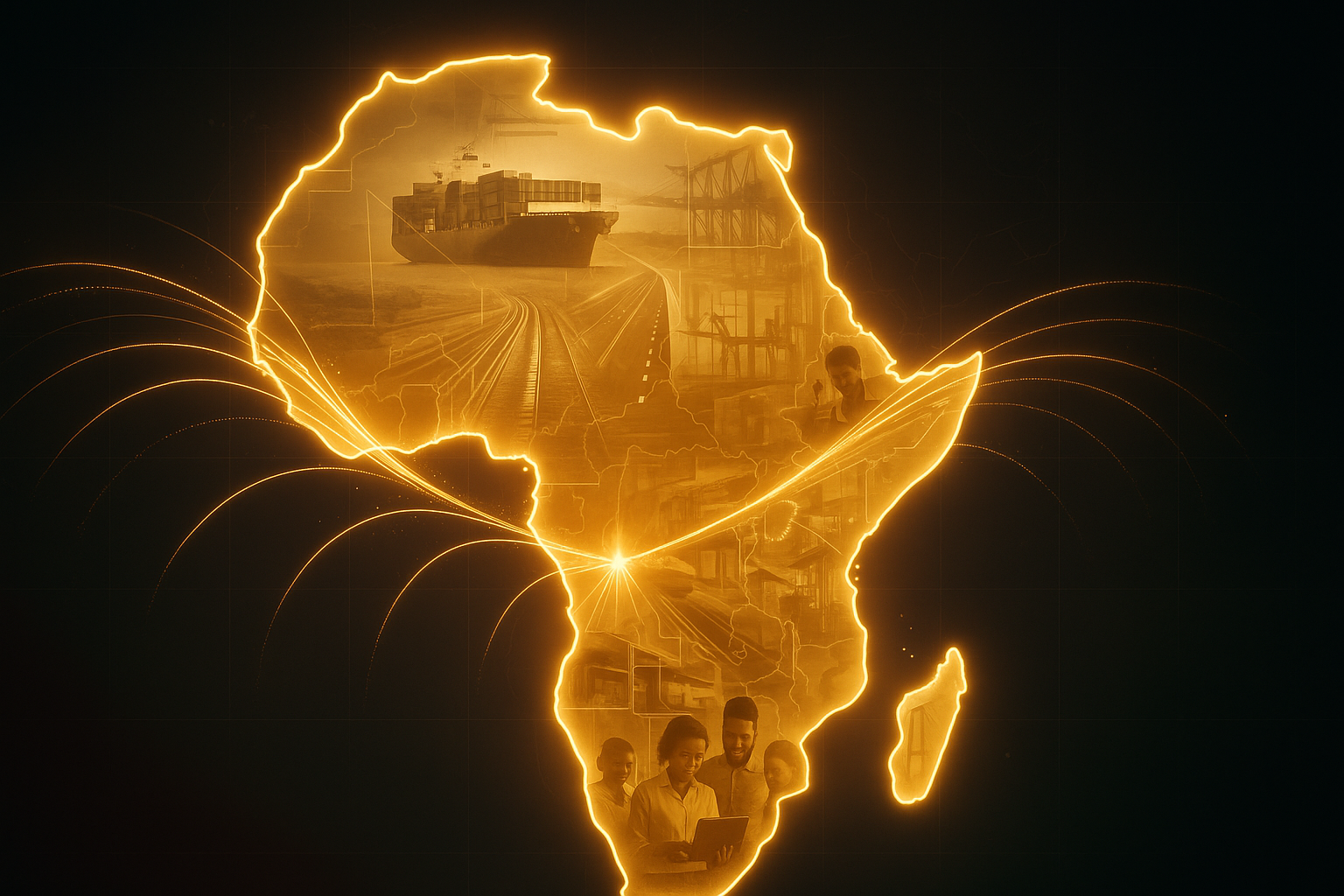
By Peter Grear with AI assistance
Date: October 3, 2025
The African Continental Free Trade Area (AfCFTA) represents one of the most ambitious projects of economic integration ever attempted on the continent. Since its launch in 2018 and operationalization in 2021, AfCFTA has been hailed as a bold step toward transforming Africa’s fragmented markets into a unified economic powerhouse. With 54 out of 55 African Union member states signing on—Eritrea being the lone exception—the initiative signals a continental commitment to reshape Africa’s role in global trade and development.
At its core, AfCFTA is designed to create the world’s largest free trade area by number of countries, covering 1.4 billion people and a combined GDP exceeding $3.4 trillion. This scale alone positions Africa as a potential rival to other major trade blocs such as the European Union, ASEAN, and USMCA. But beyond size, the initiative is meant to unlock Africa’s latent wealth by shifting from the export of raw materials to building value-added industries, regional supply chains, and a stronger negotiating hand in global commerce.
Core Objectives of AfCFTA
The framework is built on several strategic objectives. First, it seeks to eliminate tariffs on up to 90 percent of goods, reducing barriers that have long made it cheaper for African countries to trade with Europe or Asia than with their immediate neighbors. By cutting these internal barriers, AfCFTA intends to boost intra-African trade, which currently sits at around 15 percent of total trade—far below levels in other regions of the world.
Second, AfCFTA promotes the free movement of goods, services, people, and investments across the continent. For too long, African entrepreneurs and businesses have struggled with customs delays, complex regulatory regimes, and protectionist policies. By streamlining rules and standardizing practices, the agreement aspires to create a more predictable, competitive environment for business.
Third, the pact supports industrialization and value addition within Africa, countering the colonial legacy that left the continent dependent on exporting raw materials. With AfCFTA, the goal is for Africa to produce not just cocoa beans, but also chocolate; not just cobalt, but also batteries and electronics.
Finally, AfCFTA aligns with the African Union’s Agenda 2063, the long-term vision of a prosperous, integrated, and globally influential Africa.
Potential Benefits
The benefits projected from AfCFTA are transformative. Analysts estimate that intra-African trade could increase by more than 50 percent once implementation is complete. This growth has the potential to create millions of jobs, especially for Africa’s burgeoning youth population and for women, who dominate informal trade networks.
Industrialization is another major prize. With harmonized rules and larger markets, African manufacturers can scale production, diversify exports, and compete more effectively with imports from Asia and Europe. This process will reduce the continent’s overreliance on external markets, allowing Africa to build resilience against global supply chain disruptions.
The agreement also creates new pathways for the African diaspora. By aligning regulations across the continent, AfCFTA provides opportunities for diaspora entrepreneurs, investors, and professionals to partner with African firms on equal footing. For those committed to Pan-African economic liberation, AfCFTA is a mechanism to channel skills, capital, and networks into tangible development outcomes.
Challenges on the Road Ahead
Despite its promise, AfCFTA faces formidable obstacles. Infrastructure gaps—from inadequate roads and railways to underdeveloped ports and digital networks—pose major hurdles. Even if tariffs are removed, goods cannot move efficiently without proper transport and logistics.
Non-tariff barriers, such as customs delays, corruption, and conflicting standards, continue to stifle trade. These issues require political will and sustained reform, not just technical agreements.
Unequal development across African states is another concern. Larger economies like Nigeria, South Africa, and Egypt may reap benefits more quickly than smaller or less diversified economies, potentially widening inequalities within the continent.
Implementation speed also varies. While some countries are moving aggressively to align tariffs and regulations, others lag behind due to domestic politics or weak institutions. Moreover, political instability and regional conflicts threaten to disrupt key trade corridors, undermining confidence in the system.
Progress to Date
Despite these challenges, notable progress has been made. AfCFTA is being rolled out in phases. Phase I focuses on trade in goods and services, tariff schedules, and rules of origin. Phase II covers investment, competition policy, and intellectual property rights. Phase III, still in development, will tackle digital trade and e-commerce, which are increasingly central to modern economies.
A key milestone has been the establishment of the Pan-African Payment and Settlement System (PAPSS). This innovation allows cross-border trade to be conducted in local currencies, reducing reliance on the U.S. dollar or euro and lowering transaction costs. Pilot trading programs launched in 2022 have provided valuable insights into how the system functions in practice.
Global Significance
Beyond the continent, AfCFTA is reshaping Africa’s global economic identity. By presenting itself as a unified bloc, Africa strengthens its bargaining power in negotiations with global partners such as China, the European Union, and the United States. It also positions Africa as a potential global manufacturing hub, leveraging its young workforce and abundant natural resources.
For the Global South, AfCFTA is an inspiring model of South-South cooperation, signaling that Africa is no longer content to be a passive participant in global trade. Instead, it is asserting itself as a dynamic and competitive partner.
Conclusion
The AfCFTA represents a historic opportunity to rewrite Africa’s economic story. If fully implemented, it can unlock trade, create jobs, and catalyze industrialization across the continent. Yet the path forward will demand investment in infrastructure, elimination of non-tariff barriers, and above all, strong political will.
For Africans on the continent and across the diaspora, AfCFTA offers a framework for unity and prosperity—a tangible step toward the economic liberation of Africa. Supporting its success is not just a matter of economics; it is a matter of destiny.
✅ This article was prepared by Peter Grear with AI assistance. Please support Greater Diversity News (GDN) and its mission of advancing The Economic Liberation of Africa by subscribing, donating, and sharing this work.


)
No Comments so far
Jump into a conversationNo Comments Yet!
You can be the one to start a conversation.Only registered users can comment.