
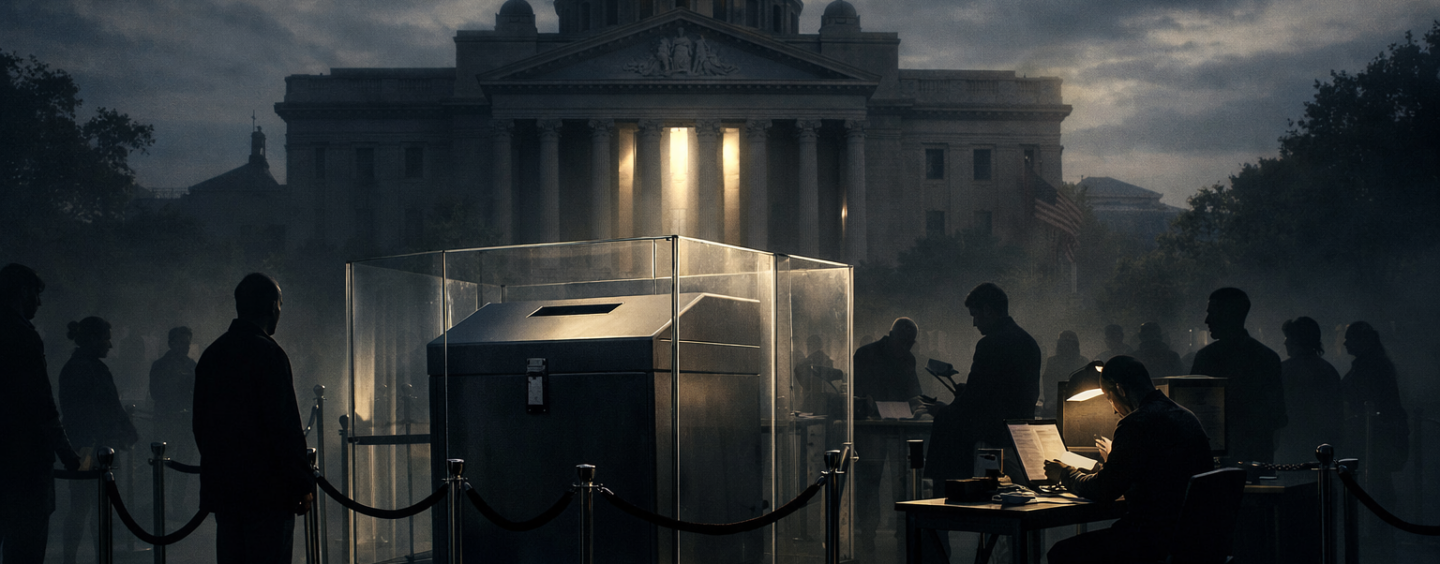
The Return of Controlled Democracy: Why Restricting Voting Is Central to Christian Nationalist Strategy

By Peter Grear, with AI assistance
January 10, 2026
Introduction: Democracy in Name Only
Democracy does not collapse all at once. It erodes quietly—through rules, thresholds, exclusions, and procedural “reforms” framed as protection. Today, the United States is witnessing a familiar pattern: a political movement that publicly celebrates freedom while privately engineering who gets to participate in it.
At the center of this contradiction is Christian Nationalism—an ideology that fuses religious identity, cultural dominance, and political power. While often framed as a moral revival, its governing strategy depends on a narrower electorate. In practice, this means controlled democracy: elections that continue to exist, but only after the electorate has been filtered.
Voting restriction is not incidental to Christian Nationalism. It is foundational.
Controlled Democracy: An Old Strategy with a New Name
Controlled democracy is not the absence of elections. It is the management of participation.
Historically, this approach has appeared whenever dominant groups feared losing power. In the post-Reconstruction South, literacy tests, poll taxes, grandfather clauses, and racial terror were used to maintain white political control while preserving the appearance of democratic governance.
Christian Nationalism follows the same logic—minus the explicit racial language.
Instead of saying “Black people should not vote,” the language has evolved to:
- “Election integrity”
- “Voter confidence”
- “Preventing fraud”
- “Restoring order”
The outcome, however, is strikingly similar: reduced participation among communities that threaten political dominance, particularly Black voters, young voters, urban populations, and low-income citizens.
Why Voting Is the Pressure Point
Christian Nationalist ideology relies on a specific vision of the nation: culturally Christian, socially hierarchical, and politically disciplined. That vision struggles to win majorities in a diverse, pluralistic society.
The response is not persuasion—it is electoral engineering.
Restricting voting achieves three strategic goals:
- It shrinks the electorate to favor older, whiter, more rural voters who align more closely with Christian Nationalist priorities.
- It neutralizes demographic change, especially the growing political influence of Black Americans, immigrants, and younger generations.
- It converts minority rule into policy power, allowing unpopular agendas to advance through institutions rather than votes.
This is why voting access—not taxation, not foreign policy, not even culture wars—is the central battleground.
Modern Tools of Voter Restriction
Today’s voter suppression does not look like firehoses or lynch mobs. It looks administrative.
Common tactics include:
- Strict voter ID laws that disproportionately affect Black, elderly, and low-income voters
- Reductions in early voting and mail-in options heavily used by working-class voters
- Aggressive voter roll purges with limited notice or recourse
- Polling place closures in urban and Black-majority neighborhoods
- Criminalization of minor voting errors
Each tactic can be defended individually. Together, they form a system.
The goal is not to eliminate elections—but to control who reaches the ballot box.
Christian Nationalism and the Theology of Exclusion
Christian Nationalism frames political participation as something to be earned, not guaranteed. Citizenship becomes conditional—measured by conformity to cultural norms rather than constitutional rights.
This theological framing matters.
If the nation is imagined as divinely ordered, then democracy becomes dangerous when it empowers those deemed “outside” the moral hierarchy. In that worldview, limiting participation is not unjust—it is righteous.
This is how voter restriction is morally justified:
- Not as oppression
- But as protection
- Not as exclusion
- But as stewardship
History shows where this logic leads.
Parallels to Jim Crow Democracy
Jim Crow was not anti-democratic in rhetoric. Southern states held elections, wrote constitutions, and passed laws. What they controlled was who counted.
Christian Nationalist strategies echo this legacy:
- Legal complexity replacing overt racial bans
- Courts replacing mobs
- Bureaucracy replacing brute force
The structure is updated. The intent remains.
A democracy that functions only when outcomes are predictable is not a democracy—it is managed consent.
Why This Moment Matters
Voting rights are not just about elections. They determine:
- Who controls school boards
- Who shapes healthcare access
- Who governs land use, housing, and policing
- Who writes the rules of economic opportunity
For Black Americans especially, voting has always been a tool of survival—not symbolism.
When voting is restricted, inequality becomes permanent.
Conclusion: Democracy Is Either Shared—or It Isn’t
Christian Nationalism’s commitment to controlled democracy reveals a fundamental truth: it cannot coexist with full participation. Its vision of the nation requires boundaries—moral, cultural, and electoral.
The struggle over voting rights today is not procedural. It is philosophical.
Will democracy belong to all—or only to those approved to inherit it?
History warns us what happens when the answer is the latter.
Join the Conversation & Support Independent Black Media
Join the conversation—leave your take or a question.
Help grow The Economic Liberation of Africa conversation—forward to someone curious about Africa-centered opportunity.
Donate to GDN – Greater Diversity News | Subscribe – Greater Diversity News



No Comments so far
Jump into a conversationNo Comments Yet!
You can be the one to start a conversation.Only registered users can comment.