
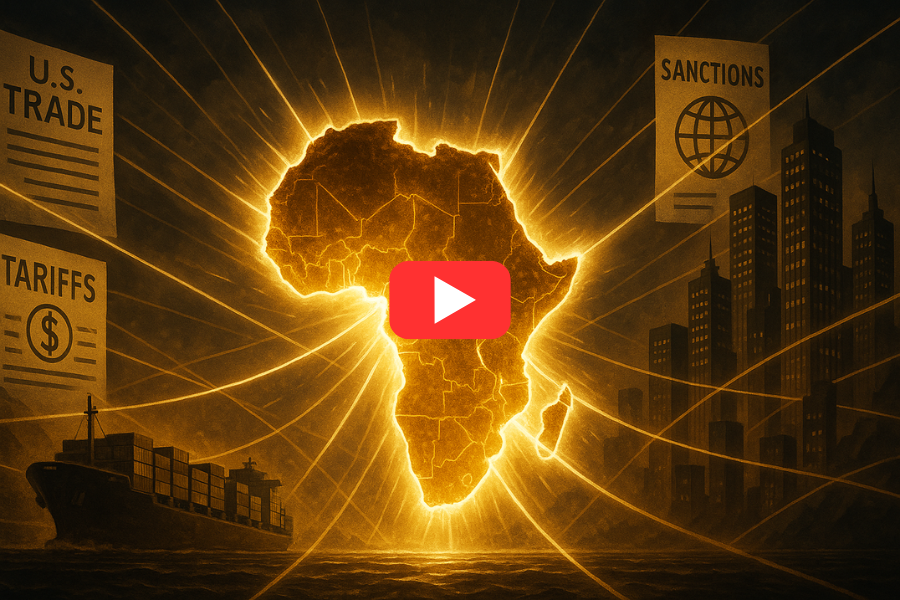
The U.S.–Africa Trade War: A New Frontline in the Struggle for Economic Liberation
By Peter Grear, with AI assistance
Published: November 25, 2025
For more than a century, Africa has been positioned as a supplier of raw materials to the world’s most powerful economies. From minerals to agriculture to energy, Western nations—especially the United States—shaped policies that kept Africa profitable for global corporations but underdeveloped for African people. Today, that old system is cracking, and a new era of conflict is emerging. It is not a war of armies. It is a war of trade, influence, resources, and narrative. And the stakes could not be higher.
What many are now calling the U.S.–Africa Trade War is the clearest sign yet that Africa is no longer playing by colonial economic rules. Across the continent—from the Sahel to Southern Africa—nations are rewriting contracts, nationalizing resources, demanding local processing, and pivoting away from Western-controlled markets. The United States, in turn, is responding with sanctions, AGOA suspensions, tariff threats, diplomatic pressure, and influence campaigns aimed at slowing Africa’s move toward economic sovereignty.
At the center of this confrontation lies a simple but transformative reality: Africa is no longer begging to participate in the global economy. Africa is becoming the global economy.
Africa’s New Economic Posture
Over the last five years, several African states have begun reclaiming control over their natural wealth. Tanzania tightened mining laws. Zimbabwe banned raw lithium exports. The Democratic Republic of Congo challenged multinational dominance over cobalt. Burkina Faso, Mali, and Niger formed a revolutionary alliance committed to breaking from Western economic dependency altogether.
This shift is not symbolic. It directly threatens the U.S. economic model that relies heavily on African minerals for electric vehicles, batteries, semiconductors, aerospace technology, and renewable energy systems. Once Africa insists on processing at home rather than exporting raw ore, American firms lose their cheapest supply chains.
The United States sees this as a risk. Africa sees it as liberation.
How the U.S. Is Fighting Back
Rather than adapt to Africa’s new expectations, the U.S. is doubling down on older strategies. AGOA, once presented as a gift to Africa, has become a political pressure tool—suspending countries for policy choices that challenge U.S. influence. Sanctions are levied in the name of democracy, but nearly always coincide with strategic economic interests. Meanwhile, U.S. diplomats aggressively warn African governments about partnerships with China, Russia, Turkey, India, and BRICS nations.
These actions signal what Washington fears: Africa is shifting its alliances—and its future—toward the Global South.
The U.S. wants Africa open, compliant, and integrated into Western systems controlled by American corporations. But a growing number of African nations want something else entirely: sovereignty, processing power, and the right to negotiate on equal footing.
Why This Trade War Matters to the Diaspora
For African Americans and the global African diaspora, this is not a distant geopolitical drama. It is an unprecedented opportunity.
For the first time in modern history, African governments are actively seeking:
- diaspora investors
- diaspora-owned manufacturing firms
- diaspora-based tech partners
- diaspora participation in national development
- Right-of-First-Refusal agreements favoring diaspora entrepreneurs
Africa is turning outward, not for charity but for partnership—and specifically toward its sons and daughters abroad.
If the U.S.–Africa Trade War represents a clash of economic empires, it also represents an open door for diaspora economic liberation.
A Defining Moment for The Economic Liberation of Africa
The question for our community is simple:
Will we engage this moment, or will we let others define Africa’s future without us?
The U.S.–Africa Trade War is not just about policy. It is about narrative, agency, and who has the right to shape the destiny of the African world. Greater Diversity News, The Economic Liberation of Africa, and our Pan-African networks must ensure that our people understand what is happening and how to move strategically within it.
Africa’s rise is not a threat to us. It is our greatest opportunity.
Africa’s sovereignty is not America’s loss. It is Black America’s gain.
And this trade war is not a crisis. It is an awakening.
The world is changing, and Africa is stepping into its rightful place.
The only question left is whether we will step with her.
Donate to GDN – Greater Diversity News | Subscribe – Greater Diversity News
Join the conversation—leave your take or a question.
Help grow The Economic Liberation of Africa conversation—forward to someone curious about Africa-centered opportunity.



No Comments so far
Jump into a conversationNo Comments Yet!
You can be the one to start a conversation.Only registered users can comment.