
The US Supreme Court: What Is Its Role and Its Powers?
The US Supreme Court is in the news around the world. The reason: a series of decisions which are already having – and will continue to have – a massive impact on the lives of ordinary Americans.
The Dobbs v Jackson Women’s Health Organization ruling gathered the most coverage, hardly surprising for a decision which overturned Roe v Wade and ended national protection for accessing abortion services after 49 years. But the day before, on June 23, the court also expanded the right to publicly carry weapons (in the aftermath of two mass shooting events and the passage of the first federal gun control legislation since the 1990s).
It has also fundamentally reinterpreted the relationship between church and state, by lowering what has for decades been described as the “wall of separation” between the institutions of government and those of the church. Holding that excluding religion from government consideration discriminates against people of faith. The ruling makes even more religion in public life possible.
And the court also restricted the power of federal agencies to take actions not explicitly handed to them by Congress. It held that the Environmental Protection Agency, a national government body, cannot regulate carbon emissions from coal-fired power plants. This could severely restrict US president Joe Biden’s climate change agenda if states are no longer bound by strict carbon emissions limits.
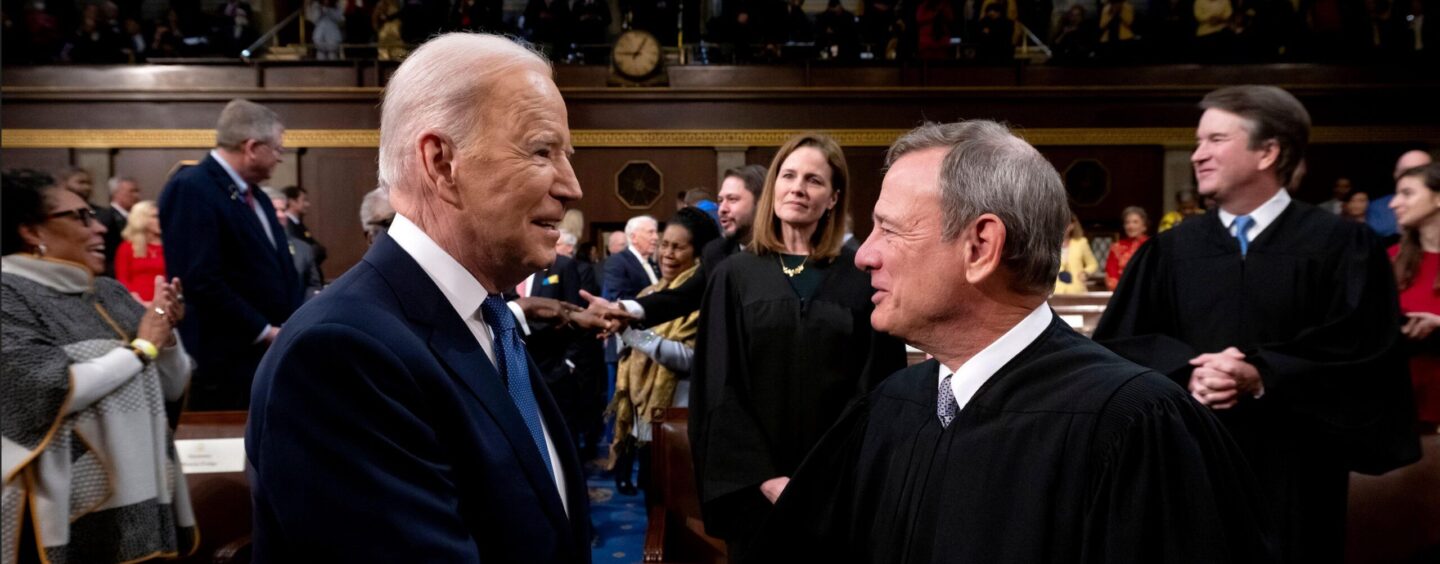
In all of these cases the three conservative justices appointed by former president Donald Trump (Neil Gorsuch, Brett Kavanaugh, Amy Coney Barrett) were in the majority, with the court’s three liberals (Stephen Breyer, Sonia Sotomayor, Elena Kagan) in the minority.
The court sits at the top of the nation’s legal system. On the lower level are the trial courts, those that initially hear cases, often with a jury. Then there are a level of appeals courts which hear challenges to the result or the procedure followed by the trial court. Each state then has its own supreme court responsible for interpreting state laws and constitutions. If, however, a case involves federal law or the US constitution, the document which created and governs the system of government, the parties may appeal to the supreme court.
The chances of cases reaching the supreme court are small. It is asked to review more than 8,000 cases every year and only generally accepts around 60-70 of those. The cases that do make it, though, are usually important. Since 1925 the nine justices who make up the court have held the power to decide which cases they hear. Since then, cases must meet certain criteria to be heard by the court. They must pose a substantial question of federal (national) law; there must be a genuine dispute; and there must be a legal remedy that falls within the power of the court. Understanding the court often means understanding why it took a particular case at a particular moment in time.
Holding Congress to account
Judicial review is the term given to the court’s power to review legislation that potentially conflicts with either federal law or the constitution, including any of the 27 amendments made since it was originally written. Among the most significant of these are the rights to freedom of religion, speech, and press (first amendment), the right to bear arms (second amendment), and the right to silence (fifth amendment).
Article III of the constitution implies the power of judicial review, since it states the powers of a supreme court shall extend to disputes under the constitution and the laws of the nation.
Those who wrote the constitution hoped to ensure the court could act as a check and a balance on the other government branches. They were fearful of creating an overly powerful central government similar to that of Britain, against which they had just fought a revolution.
Judicial review was firmly established in an 1803 case, Marbury v Madison. There, the then chief justice, John Marshall, declared that not only was the constitution superior to all other ordinary legislation, but that when there was doubt about whether laws were in conflict with constitutional provisions it was the court’s role to adjudicate. “It is emphatically the province and duty of the judicial department to say what the law is,” Marshall wrote.
The modern power of the court dates from this decision. And, although deciding the meaning of the constitution makes up a small proportion of the court’s work, the principles involved are often so crucial and so divisive that these are the cases which most often make the headlines.
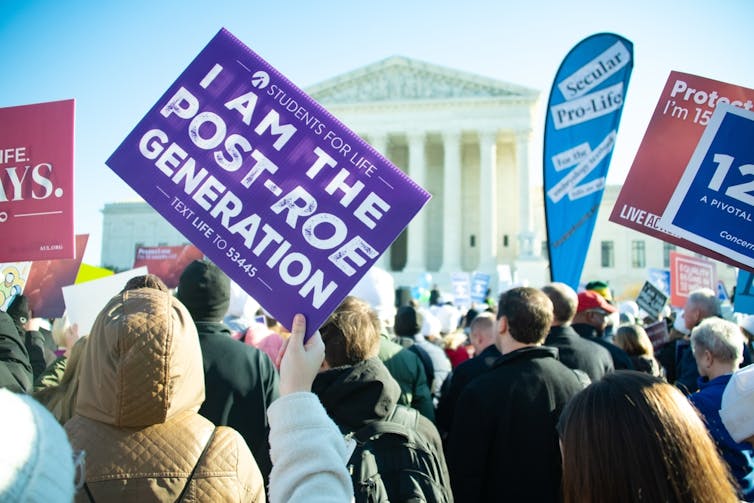
Protests have happened across the US, after the supreme court’s decision on the national right to abortion. Rena Schild/Shutterstock
Inside politics
The court has never been far from the major political issues of the day. Marshall pushed the court towards support of greater federal power at the expense of the states, one of the fundamental questions shaping the new nation. In the middle of the 19th century, when the nation was riven by the question of slavery, a court dominated by southern slave-holding justices ruled in Dred Scott v Sandford that the constitution never intended to extend citizenship to people of African descent. The ruling deepened the tensions that led to the American Civil War.
Half a century later, in another decision widely condemned today, the court ruled that it did not violate the constitution to have “separate but equal” public services based on race, in this instance railroad carriages. This effectively gave legal sanction to the “Jim Crow laws” that would keep the southern states segregated until the court reversed itself in Brown v Board of Education in 1954. And, in the mid-1930s, as Congress and the then president, Franklin Roosevelt, sought to address the economic crisis of the Great Depression with a legislative programme known as the New Deal, a conservative court repeatedly struck down core programmes until a shift in 1936 saw the justices reverse this course. Shortly afterwards a series of retirements allowed Roosevelt to make a series of new appointments who were more sympathetic to his legislative program.
But especially in the period known as the “rights revolution” from the late 1950s through to the early 1970s, the court extended constitutional protections to unpopular and marginalised minorities otherwise ignored or hurt by legislatures. Jehovah’s Witnesses, Seventh-Day Adventists and other religious minorities benefited from the court’s broad readings of the first amendment’s protections for “free exercise” of religion.
The court also expanded protections for those in the criminal justice system, including the right to silence and the right to a lawyer, both considered basic in today’s society. It ensured access to contraception for married and then single women, protected many of the gains won by the civil rights movement, and ensured fair practices in voting.
In more recent years the court has also found a constitutional right to same-sex marriage and held that the 1964 Civil Rights Act protects LGBTQ+ workers from discrimination.
The supreme court is not inherently liberal or conservative, progressive or dogmatic. As an appeals court it can only respond to the cases brought before it, and those reflect the politics, culture and temperament of the times.
The court is the product of its time and the people who constitute it at any given moment. It is shaped by individuals, usually lawyers, appointed by the sitting president when a justice retires, or dies. As such, it is never entirely removed from the political process. It has been both benefit and hindrance to the US. It has protected and trampled the rights of minorities, expanded and limited the power of the federal government, resisted and encouraged social change.
The current controversies are not new. The court has been at or near the centre of national debates since its founding. Its role as a branch of government and the power of judicial review ensure it will continue to be part of controversies large and small for decades to come.