
Toggle Menu
Greater Diversity News Homepage
  • Search Jobs
    • Latest Jobs (582)
    • Send Advertisements
  • Books of Knowledge
    • Latest Books
    • Weekly eNews EditionsDownload PDFs of Weekly Classifieds
    • Get Started: Reading Order
  • The NBSM
    • About The NBSM
    • GDN NBSM Resource Links
    • The NBSM website
    • Make a donation
    • GDN Login
  • A Call to Colors
    • A Call to Colors Articles
    • About Civic Engagement Project
    • Civic Engagement Headlines
    • The Network for 2018
    • About Economic Equity
    • Economic Equity Headlines
    • GDN eNews Archives
    • Resources and Articles
  • Greater Diversity News Podcast
    • Share Your Story
  • Donate to GDN
  • Archives
  • Contact GDN
  • My Account
  • Subscribe
  • Shop Africa
  • GDN Global
US Congress Could Use Reconstruction-era Civil Rights Powers To Protect Black Lives Today

US Congress Could Use Reconstruction-era Civil Rights Powers To Protect Black Lives Today

The man in the White House doesn’t believe in racial equality. He is erratic, vain, and conspiratorial. In a speech to celebrate George Washington’s birthday, the president mentioned himself 200 times in 60 minutes. The House of Representatives voted to impeach him, but the president’s powerful son-in-law helped him to escape removal from office.

The year is 1868. The president is Andrew Johnson, the southern Democrat who succeeded Abraham Lincoln. Johnson was installed in the White House following Lincoln’s assassination on Good Friday 1865, only a week after Robert E Lee had surrendered Confederate forces in the American civil war.

In his first months as president, Johnson had appeared to be a disaster for the cause of black civil rights. He pardoned Confederate soldiers, supported white supremacist state governments, and vetoed funding for the Freedmen’s Bureau, which had been established to provide food, healthcare, education, and job security to newly emancipated slaves.

Emboldened by this anti-civil rights president, southern state governments implemented “black codes” which were designed to return African Americans as close to the position of slavery as possible. Vague crimes such as “vagrancy” – effectively, unemployment – were used to arrest African Americans who were not seen as sufficiently industrious or subservient.

Get news that’s free, independent and evidence-based

While such laws often didn’t mention race explicitly, they were used in practice to target African Americans. In some states, a sheriff could imprison anyone who could not prove that they were employed, and then the prisons could contract their labour to pay for the costs of incarceration. State governments profited handsomely.

In spite of these initial setbacks, Johnson’s presidency was also marked by some of the most important civil rights achievements for a century. This was possible because Congress governed without the president. Congress was controlled by the pro-civil rights Republican Party, which was determined not to allow the menace in the White House to undermine the victory for black equal citizenship that had just be won in the civil war. These same Reconstruction-era powers could be used today by Congress to protect the rights of African Americans.

Civil rights advanced

Under the US constitution, the president cannot block legislation which commands two-thirds support of Congress. Congressional Republicans took advantage of this power to pass laws such as the Civil Rights Act of 1866. The president also has no role in the constitutional amendment process. The most powerful and enduring legal legacy of this period of congressional governance was three amendments to the constitution known as the “Reconstruction amendments”.
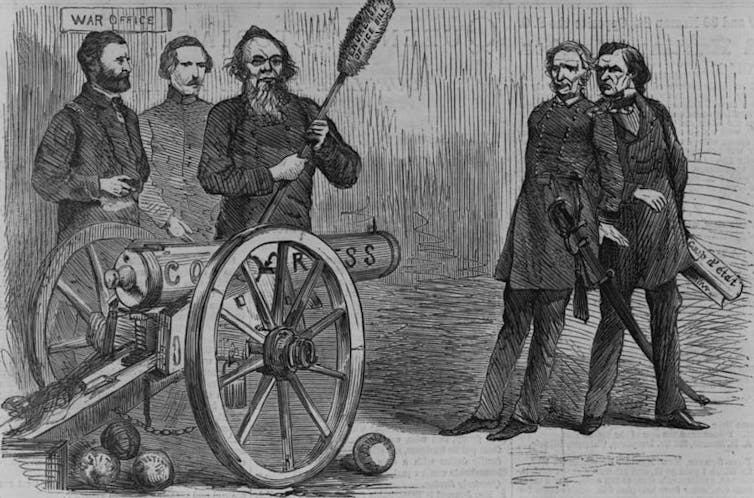
President Johnson did not have the support of the Republican-led Congress. “The Situation”, a Harper’s Weekly editorial cartoon from 1868 via Wikimedia Commons

Ratified within five years of each other, these three amendments fundamentally changed property relations, the balance of power in the state-federal relationship, and the meaning of and eligibility for US citizenship. The 13th amendment abolished slavery in 1865 (it was passed before Lincoln’s assassination but ratified during Johnson’s presidency). The 14th amendment, ratified in 1868, addressed the citizenship rights of the ex-slaves. In 1870, the 15th amendment explicitly forbade racial discrimination in voting.


Read more: How black grassroots politics led to the 14th Amendment and black citizenship


Promise of the 14th amendment

The 14th amendment was really more like four or five constitutional amendments rolled into one. The first three sections provided a constitutional basis for civil rights legislation. They guaranteed citizenship to every person born in the US, ensured equal due process, and guaranteed equal protection under the law for all Americans, regardless of which state they inhabited.

The 14th amendment also provided a constitutional basis for attacking white supremacist political power. It barred former officials who had supported the Confederacy from holding political office without Congress’s approval. It forbade the federal government from using US taxpayer money to finance Confederate war debt or to provide financial compensation for the abolition of slavery, a key difference from abolition in the British Empire in which slave-holders were compensated. Instead, Congress passed laws to compensate ex-slaves through land-redistribution – although, this programme of reparations was ultimately incomplete and underfunded.

And it implicitly guaranteed black suffrage by empowering Congress with the ability to reduce the congressional representation of any state which failed to provide universal suffrage to all men over the age of 21.

The 14th amendment was limited in its scope by the Supreme Court in the late 19th century, permitting Jim Crow segregation that deprived African Americans of their brief experience of equal citizenship. It was not until the 1950s that the Supreme Court began to roll back its earlier, narrow interpretation of the powerful amendment, for the benefit of African Americans.

An under-used tool

The powers of the Reconstruction-era amendments are still held by Congress today – but their radical potential has been underestimated.

Due to a 2013 Supreme Court decision which disabled the most powerful enforcement section of the 1965 Voting Rights Act, American jurisdictions can shape voting rules without federal approval, known as preclearance. This means states can introduce in punitive voter ID laws, engage in over-zealous voter purges, and close polling stations in predominantly black areas with much greater ease. The recent experience of voters in Georgia shows the harmful consequences of a weak Voting Rights Act.
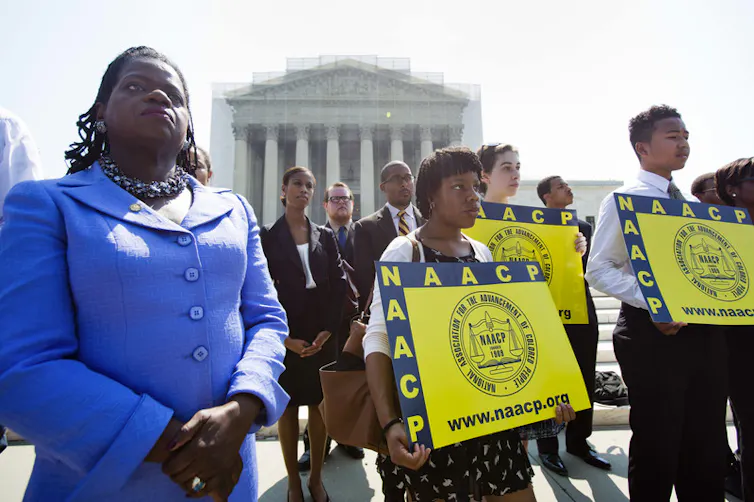
Civil rights activists outside the Supreme Court in 2013 when it struck down part of the 1965 Voting Rights Act. Jim Lo Scalzo/EPA

But, the 14th amendment is an unexplored tool to correct the Supreme Court’s disastrous decision. If the Democratic-led House of Representatives were serious about protecting black voting rights ahead of the 2020 election, it could use its constitutional powers to strip states which try to disenfranchise racial minorities of their congressional representation.

The US is plagued by a constitution which contains numerous anti-democratic elements. These include a malapportioned Senate and electoral college which grossly under-represent urban populations, an overly powerful Supreme Court, and a federal system which militates against universal rights and welfare by failing to set national standards in the face of state opposition.

But as I argue in my own recent research, there are seeds of democracy in the constitution too, especially in the three Reconstruction amendments. Johnson was constrained by a pro-civil rights Congress. The legacy of that Reconstruction era has been under-deployed by Congress today, which seemingly lacks the political will to govern on behalf of racial minorities.The Conversation

Share This Article

Do the sharing thingy


Download weekly PDF
Want to Advertise? Post Jobs
  • Public Safety Center Dry Pipe Sprinkler Renovations

    • Raleigh, NC
    • Wake County
  • Rowan Community Center Concourse & Exterior Signage Renovations

    • Salisbury, NC
    • Lomax Construction, Inc.
  • Director of Small Business Center

    • Lumberton, NC
    • Robeson Community College
  • North Regional Library Roof Replacement

    • Raleigh, NC
    • Wake County
  • Carolina Shores Wastewater Treatment Plant Clarifiers Splitter Box project

    • Supply, NC
    • State Utility Contractors, Inc.
  • (Alamance County Municipal Solid Waste Landfill – Scale House and Facility Improvements) project

    • New London, NC
    • Hamlett Associates, Inc.
  • Rowan Community Center Concourse & Exterior Signage Renovation project

    • Salisbury, NC
    • H.M. Kern Corporation
  • RCCC Hydraulic Elevator Modernization project

    • Richmond County, NC
    • H.M. Kern Corporation
  • Apex Town Hall Human Resources Office Renovations,

    • Apex, NC
    • Lomax Construction
  • Biltmore Hills Park Tennis Improvements: 2615 Fitzgerald Drive,

    • Raleigh, NC
    • Bar Construction Co., Inc.
  • Weatherspoon Art Museum – Center for Art and Human Understanding: 1005 Spring Garden Street,

    • Greensboro, NC
    • Bar Construction Co., Inc.
  • GoCary Bus Operations and Maintenance Facility: 160 Towerview Ct.

    • Cary, NC
    • Bar Construction Co., Inc.
  • Carolina Shores WWTP Clarifiers Splitter Box

    • Brunswick County, NC
    • Turner Murphy Company, Inc.
  • Winston-Salem State University for the Hauser Hall Renovation & Addition

    • Winston-Salem, NC.
    • The Christman Company
  • Plumbing and Electrical Contractors

    • Raleigh, NC
    • Resources for Seniors, Inc.
  • HVAC Contractors

    • Raleigh, NC
    • Resources for Seniors, Inc.
  • Insulation and Air-Sealing Contractors

    • Raleigh, NC
    • Resources for Seniors, Inc.
  • Canton Town Hall & Canton Police Department Renovations

    • Canton NC
    • Haynes Electric
  • Tall Glass of Water – Phase II

    • Wilmington, NC
    • A. R. Chesson Construction
  • NCDAC Sampson CI Gatehouse project

    • Sampson County, NC
    • H.M. Kern Corporation
  • Alamance County Scale House & Facility Improvements project

    • Alamance County, NC
    • H.M. Kern Corporation
  • Taxilane and 6-Unit T-Hangar and Fireline Extension – Aulander, NC.

    • Aulander, NC
    • A. R. Chesson Construction
  • Demolishing Existing Chlorine contact basin and building a new splitter structure and pipes connecting to existing clarifiers

    • Brunswick County, NC
    • Harper General Contractors
  • Mitchell County out for bid: C-C11828 Mountain View CI Emergency Roof Replacement.

    • Mitchell County, NC
    • North Carolina Department of Adult Correction
  • Old Cafeteria Replacement Steam Manhole & Condensate Piping project, SCO ID# 22-24436-01B

    • Greenville, NC
    • East Carolina University  
  • Caton Fieldhouse and Auxiliary Services RTU Replacements

    • Pembroke, NC
    • University of North Carolina at Pembroke
  • Somerset – Collins House HVAC Repair

    • Creswell, NC
    • A. R. Chesson Construction
  • City of Morganton Bethel Park Restroom Facilities

    • Morganton, NC
    • Wilkie Construction Company
  • 127 Main Street Restoration

    • Laurinburg, NC
    • City of Laurinburg
  • Chavis Building 2nd Floor HVAC Renovation

    • Pembroke, NC
    • University of North Carolina at Pembroke
  • Astor Dowdy Towers and Elm Towers Fire Alarm Replacements 20260401

    • High Point, NC
    • Housing Authority of the City of High Point
  • HVAC Water Chemical Treatment

    • Wilmington, NC
    • New Hanover County Schools
  • School Grounds Maintenance

    • Wilmington, NC
    • New Hanover County Schools
  • Haywood County School Complex Phase I Project

    • Waynesville, NC
    • Buchanan and Sons, Inc.
  • Southern Guilford High School Fire Alarm Installation Project.

    • Greensboro, NC
    • Beco, Inc.
  • Taxilanes and 6 Unit T-Hangar and Fireline Extension

    • Aulander, NC
    • A.R. Chesson Construction
  • Water & Wastewater Infrastructure Improvements

    • Bakersville, NC
    • Town of Bakersville
  • Metropolitan Wastewater Treatment Plant Thickening Improvements project,

    • Columbia, SC
    • State Utility Contractors
  • Dobson, NC (Surry County) – Ridge Road Pump Station & Force Main Replacement. PROJECT NO. SRP-W-134-002 (Advertisement for Re-Bid)

    • Surry County, NC
    • Jimmy R. Lynch & Sons, Inc
  • Municipal Building Capital Repairs & Restoration project

    • Asheville, NC
    • Frank L. Blum Construction Company
  • Iredell County Farmers Market

    • Troutman, NC
    • Frank L. Blum Construction Company
  • Program Director for Social and Human Services Technology

    • Lumberton, NC
    • Robeson Community College
  • Vice President of Student Services

    • Lumberton, NC
    • Robeson Community College
  • UNC Health Johnston-Bed Tower Expansion

    • Clayton, NC
    • T & H Electrical Corporation
  • OCS Media Center Renovations project

    • Winston Salem, NC
    • H.M. Kern Corporation
  • Wake County Public School System: North Garner Middle School. Garner, NC, No. BP-0840Aluminum/ Glass

    • Pelham, NC
    • Carolina Classic Window & Glass, Inc.
  • Piedmont Community College (CEAD) No. BP-08A: Aluminum Storefront & Glazing

    • Pelham, NC
    • Carolina Classic Window & Glass, Inc.
  • Orange County Media Center Renovations

    • Hillsborough, NC
    • Lomax Construction
  • Sealed Bid Auction of Appliances and Miscellaneous Equipment

    • High Point, NC
    • Housing Authority of the City of High Point
  • Executive Operations Administrative Assistant

    • Wilmington , NC
    • Wilmington Housing Authority
.
  • Refund Policy
  • Privacy Policy
  • Terms & Conditions Policy
  • Contact Us
  • Job Posting
  • GDN eNews Subscription for Economic Equity Updates
  • Subscribe

Designed by Orange-Themes.com

  Close Window

Loading, Please Wait!

This may take a second or two. Loading
Verified by MonsterInsights